



|
home ao english musik literatur journalismus bilder sprachen mehr shop sitemap | |
In Indien 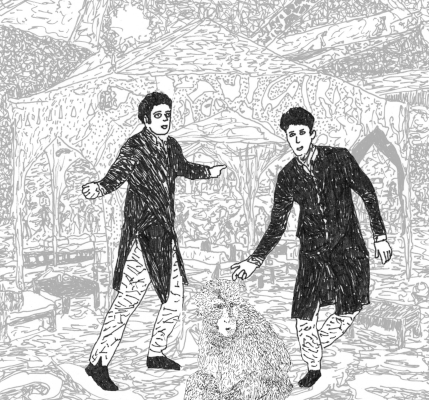 |
In India |
En Inde |
In India |
En la India |
(Deutsch) Dies ist die linguistische Version der fünfzehnten Staffel der Jungs. Die Texte sind dieselben wie auf der Hauptseite. |
(English) This is the linguistic version of the fifteenth season of the Boys. The texts are the same as on the main page. |
(Français) Voici la version linguistique de la quinzième saison des Gars. Les textes sont les mêmes que sur la page principale. |
(Italiano) Questa è la versione linguistica della quindicesima stagione dei Ragazzi. I testi sono gli stessi della pagina principale. Colori: parole singole (verde) frasi nominali (azzurro) frasi verbali (ocra) modi di dire + collocazioni (rosso) parolacce + onomatopea + giochi di parole + citazioni (viola) |
(Español) Esta es la versión lingüística de la decimoquinta temporada de los Chicos. Los textos son los mismos que en la página principal. |
(English) Heinz is upset, because two days earlier the Empire started a major war. Not in a simulation, but here with us on Earth. Helmut understands his friend's feelings and thoughts, but also recognizes his shortcomings. Luckily, there is a solution. |
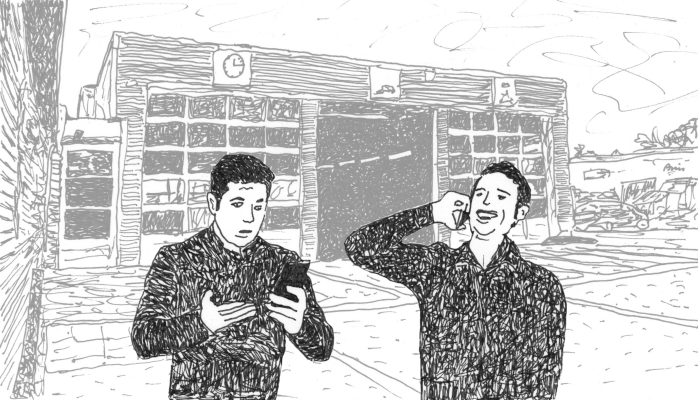 |
(Italiano) Heinz è sconvolto, perché due giorni prima l'Impero ha scatenato una grande guerra. Non in una simulazione, ma qui da noi sulla Terra. Helmut comprende i sentimenti e i pensieri del suo amico, ma riconosce anche le sue lacune. Per fortuna c'è una soluzione. |
(Deutsch) Heinz ist aufgebracht, denn zwei Tage zuvor hat das Imperium einen großen Krieg vom Zaun gebrochen. Nicht in einer Simulation, sondern hier bei uns auf der Erde. Helmut versteht die Gefühle und Gedanken seines Freundes, erkennt aber auch seine Defizite. Zum Glück gibt es eine Lösung. Normal Version | ||
Beim TÜV Tag 1 1 Helmut: OK, der Meister sagt, dass sie gleich fertig sind. Sieht alles gut aus. Deine Befürchtungen waren unbegründet. |
Day 1 Helmut: OK, the mechanic says they'll be done in a minute. Everything looks good. Your fears were unfounded. |
Jour 1 Helmut : OK, le chef dit qu'ils auront bientôt terminé. Tout a l'air en ordre. Tes craintes étaient infondées. |
Giorno 1 Helmut: OK, il capo dice che hanno quasi finito. Sembra tutto a posto. Le tue preoccupazioni erano infondate. |
En la ITV Día 1 Helmut: OK, el jefe dice que ya casi terminan. Todo parece estar bien. Tus temores eran infundados. |
2 Heinz: Die Sonne scheint?? Ich brauch eine andere Einstellung zu den Dingen?? Bist du irre? Ich war gerade dabei, mich zu beruhigen, da kommst du mit ... ♪ Always look on the bright side of life. - Ja, genau. Was war das denn? |
Heinz: The sun is shining?? I need a different attitude toward things?? Are you insane? I was just about to calm down and then you come along with... ♪ Always look on the bright side of life. - Yeah, exactly. What was that? |
Heinz : Le soleil brille ?? J'ai besoin de changer mon attitude ?? T'es dingue ? J'étais justement en train de me calmer et voilà que tu arrives avec... ♪ Always look on the bright side of life. - Oui, voilà. C'était quoi, ça ? |
Heinz: Il sole splende?? Devo cambiare atteggiamento?? Sei impazzito? Stavo appena riuscendo a calmarmi e poi arrivi tu con... ♪ Always look on the bright side of life. - Sì, esatto. Ma cos'era quello? |
Heinz: ¿¿El sol brilla?? ¿¿Necesito otra actitud ante las cosas?? ¿Estás loco? Justo estaba empezando a calmarme y vienes tú con… ♪ Always look on the bright side of life. - Sí, exactamente. ¿Qué ha sido eso? |
3 Helmut: Morgen? Nein, Schätzchen, das geht nicht. Wir müssen erst mal alles vorbereiten und ein Visum beantragen. |
Helmut: Tomorrow? No, sweetie, that won't work. We first have to prepare everything and apply for a visa. |
Helmut : Demain ? Non, ma chérie, ce n'est pas possible. On doit d'abord tout préparer et demander un visa. |
Helmut: Domani? No, tesoro, non è possibile. Dobbiamo prima preparare tutto e richiedere un visto. |
Helmut: ¿Mañana? No, cariño, eso no puede ser. Primero tenemos que prepararlo todo y solicitar un visado. |
4 Heinz: Wie soll das gehen? Affen haben gar nicht die körperlichen Voraussetzungen, um artikulierte Laute von sich zu geben. |
Heinz: How is that possible? Monkeys don't even have the physical prerequisites to produce articulated sounds. |
Heinz : Comment est-ce possible ? Les singes n'ont même pas les prérequis physiques pour produire des sons articulés. |
Heinz: Come sarebbe possibile? Le scimmie non hanno nemmeno i presupposti fisici per produrre suoni articolati. |
Heinz: ¿Cómo va a ser eso? Los monos ni siquiera tienen los requisitos físicos para producir sonidos articulados. |
(English) Heinz and Helmut drive into the city to buy a guest gift for Aouda. As they stroll along the pedestrian zone from Neubrunnenplatz, Heinz notices that his friend is behaving strangely. Helmut can explain. |
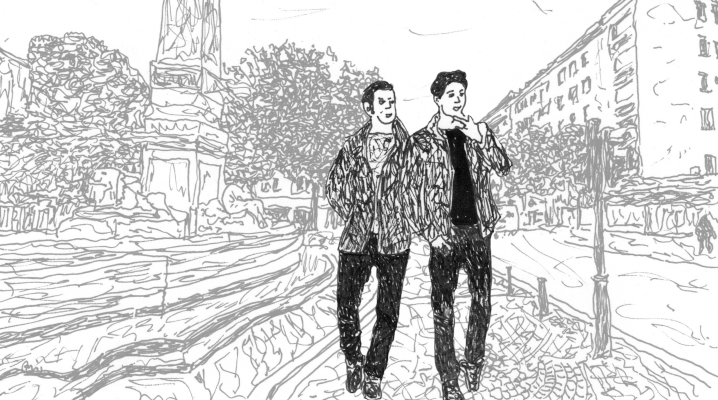 |
(Italiano) Heinz e Helmut vanno in città per comprare un regalo per Aouda. Mentre passeggiano lungo la zona pedonale partendo da Neubrunnenplatz, Heinz nota che il suo amico si comporta in modo strano. Helmut può spiegarlo. |
(Deutsch) Heinz und Helmut fahren in die Stadt, um ein Gastgeschenk für Aouda zu kaufen. Während sie vom Neubrunnenplatz aus die Fußgängerzone entlangschlendern, fällt Heinz auf, dass sein Freund sich auffällig verhält. Helmut kann das erklären. Normal Version | ||
Tag 27 1 Heinz: Aoudas Betreuer hat uns eine Mail geschrieben. Ranjid. Unsere Zimmer sind hergerichtet und wir werden freudig erwartet. Oh, verdammt, das ist unsere Haltestelle! Schnell! |
Day 27 Heinz: Aouda's caretaker sent us an email. Ranjid. Our rooms are prepared and we're being eagerly awaited. Oh, damn, that's our stop! Quick! |
Jour 27 Heinz : Le gardien d'Aouda nous a écrit un mail. Ranjid. Nos chambres sont prêtes et on est attendus avec joie. Oh, mince, c'est notre arrêt ! Vite ! |
Giorno 27 Heinz: Il custode di Aouda ci ha scritto una mail. Ranjid. Le nostre stanze sono pronte e ci aspettano con gioia. Oh, cavolo, questa è la nostra fermata! Presto! |
Día 27 Heinz: El cuidador de Aouda nos ha escrito un correo. Ranjid. Nuestras habitaciones están preparadas y nos esperan con alegría. Oh, demonios, ¡esta es nuestra parada! ¡Rápido! |
2 Heinz: Sag mal ... |
Heinz: Say… |
Heinz : Dis donc… |
Heinz: Senti un po'… |
Heinz: Oye… |
3 Heinz: Wie du meinst. Übermorgen geht es ja auch endlich los. Hat leider ein bisschen länger gedauert bei mir. |
Heinz: Whatever you say. The day after tomorrow it finally starts. Unfortunately it took me a bit longer. |
Heinz : Comme tu veux. Après-demain, ça commence enfin. Ça m'a malheureusement pris un peu plus de temps. |
Heinz: Come vuoi. Dopodomani finalmente si parte. Purtroppo con me ci è voluto un po' più di tempo del previsto. |
Heinz: Como quieras. Pasado mañana por fin empieza. Por desgracia, me ha llevado un poco más de tiempo. |
4 Helmut: Hallo! Ist hier jemand? Ah, guten Tag. Ich hätte gern das Glitzerkleidchen. Gibt es das in verschiedenen Größen? Äh, nein, für einen Makaken. Genau. Ein Gastgeschenk. |
Helmut: Hello! Is anyone here? Ah, good afternoon. I'd like the glitter dress, please. Does it come in different sizes? Uh, no, for a macaque. Exactly. A guest gift. |
Helmut : Bonjour ! Il y a quelqu'un ? Ah, salut. Je voudrais la robe scintillante. Est-ce qu'elle existe en différentes tailles ? Euh, non, pour un macaque. Exactement. Un cadeau d'hôte. |
Helmut: Buongiorno! C'è qualcuno? Ah, salve. Vorrei il vestitino scintillante. Esiste in diverse taglie? Eh, no, per un macaco. Esatto. Un regalo per gli ospiti. |
Helmut: ¡Hola! ¿Hay alguien? Ah, buenas tardes. Quisiera el vestidito brillante. ¿Lo hay en diferentes tallas? Eh, no, para un macaco. Exacto. Un regalo de anfitrión. |
(English) Fanni pulled some strings and, together with her assistant Jenny, found a place in Frankfurt’s upscale West End where Fiona can try out her healing skills in front of an audience for the first time. The hostess, a countess, is thrilled. |
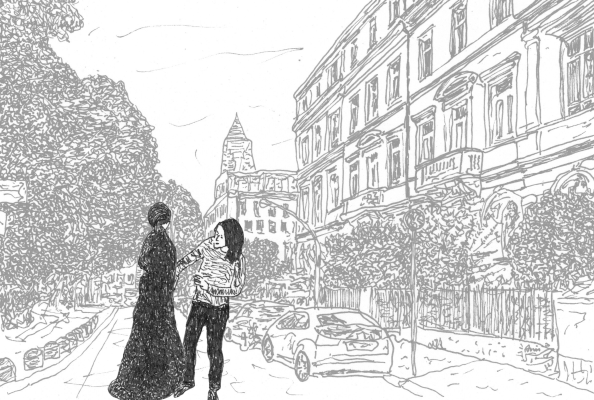 |
(Italiano) Fanni ha sfruttato le sue conoscenze e, insieme alla sua assistente Jenny, ha trovato un luogo nel quartiere elegante di Francoforte dove Fiona può provare per la prima volta le sue arti curative davanti a un pubblico. La padrona di casa, una contessa, è entusiasta. |
(Deutsch) Fanni hat ihre Beziehungen spielen lassen und mit ihrer Assistentin Jenny einen Ort im Frankfurter Nobelviertel gefunden, wo Fiona ihre Heilkünste zum ersten Mal an einem Publikum ausprobieren kann. Die Gastgeberin, eine Gräfin, ist begeistert. Normal Version | ||
Bei der Gräfin Tag 31 1 Fanni: Ein Parkplatz direkt vor dem Haus. Und das im Frankfurter West-End. Wenn das kein gutes Omen ist! Jenny hat mir grad getextet, dass sie drinnen mit den anderen auf uns wartet. |
Day 31 Fanni: A parking spot right in front of the house. And in Frankfurt's West End, no less. If that's not a good omen! Jenny just texted me that she's inside waiting for us with the others. |
Jour 31 Fanni : Une place de parking juste devant la maison. Et en plus, dans le West End de Francfort. Si c'est pas un bon présage ! Jenny vient de m'envoyer un message, elle est à l'intérieur avec les autres, ils nous attendent. |
Giorno 31 Fanni: Un parcheggio proprio davanti alla casa. E per di più nel West End di Francoforte. Se non è un buon presagio! Jenny mi ha appena scritto che è dentro con gli altri e ci aspetta. |
Día 31 Fanni: Un aparcamiento justo delante de la casa. Y nada menos que en el West End de Fráncfort. ¡Si eso no es un buen presagio! Jenny acaba de escribirme que está dentro con los demás esperándonos. |
2 Fiona: Ich kann kaum atmen in dem Ding. War das wirklich nötig? |
Fiona: I can barely breathe in this thing. Was that really necessary? |
Fiona : J'arrive à peine à respirer là-dedans. C'était vraiment nécessaire ? |
Fiona: Riesco a malapena a respirare con questo coso. Era davvero necessario? |
Fiona: Apenas puedo respirar con esto. ¿De verdad era necesario? |
3 Fiona: Danke, Frau ... äh, Haushälterin. Ich würd es selbst aufheben, aber ich kann mich in diesem Ding nicht bücken. |
Fiona: Thank you, Mrs... uh, housekeeper. I'd pick it up myself, but I can't bend over in this thing. |
Fiona : Merci, Madame... euh, la gouvernante. Je le ramasserais bien moi-même, mais je peux pas me pencher dans ce truc. |
Fiona: Grazie, signora... eh, governante. Lo raccoglierei io, ma non riesco a piegarmi con questo coso. |
Fiona: Gracias, señora... eh, ama de llaves. Lo recogería yo misma, pero no puedo agacharme con esto. |
4 Fanni: Fangen wir an mit den Kopfschmerz- und Tinnitus-Leuten! Wo ...? OK, da am Fenster. Und die Schnupfen-, Erkältungs- und Bronchienleute? Sie? Ach so, Sie sind die Ausschlag- und Hautleute. Und Sie? Nein, sagen Sie nichts. Tics, richtig? Ich wusste es. |
Fanni: Let's start with the headache and tinnitus people! Where...? OK, over there by the window. And the sniffles, cold, and bronchial people? You? Oh, you're the rash and skin people. And you? No, don't say anything. Tics, right? I knew it. |
Fanni : Commençons par les gens qui ont des maux de tête et des acouphènes ! Où... ? OK, là-bas près de la fenêtre. Et les rhumes, refroidissements et bronches ? Vous ? Ah, vous êtes les problèmes de peau et les éruptions cutanées. Et vous ? Non, dites rien. Des tics, c'est ça ? Je le savais. |
Fanni: Cominciamo con i mal di testa e gli acufeni! Dove...? OK, là alla finestra. E quelli con raffreddore, influenza e bronchi? Voi? Ah, voi siete eruzioni e problemi di pelle. E voi? No, non dica nulla. Tic, giusto? Lo sapevo. |
Fanni: ¡Empecemos con los de dolor de cabeza y tinnitus! ¿Dónde...? Vale, allí junto a la ventana. ¿Y los de resfriado, gripe y bronquios? ¿Ustedes? Ah, ustedes son los de erupciones y piel. ¿Y ustedes? No diga nada. Tics, ¿verdad? Lo sabía. |
(English) Heinz has been lying sick in his room at the camp for two days because of a yogurt drink he didn’t tolerate. The little monkey Aouda is taking very sweet care of him. Helmut comes in after having been in the village and tells his friend the latest news. |
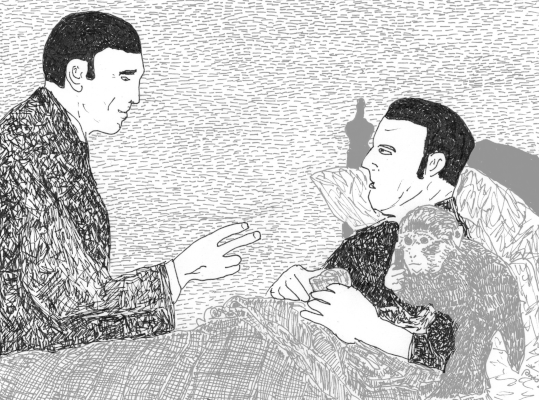 |
(Italiano) Heinz è sdraiato da due giorni nella sua stanza al campo a causa di una bevanda allo yogurt che non gli ha fatto bene. La scimmietta Aouda si prende cura di lui con molta premura. Helmut arriva dopo essere stato nel villaggio e racconta al suo amico le ultime novità. |
(Deutsch) Heinz liegt seit zwei Tagen krank in seinem Zimmer im Camp, weil er ein Joghurt-Getränk nicht vertragen hat. Das Äffchen Aouda kümmert sich rührend um ihn. Helmut kommt dazu, nachdem er im Dorf gewesen ist, und erzählt seinem Freund das Neuste. Normal Version | ||
Tag 32 1 Heinz: Oh, Mann. Stöhn. Was ...? Aouda, bist du das? Was hast du da mitgebracht? Oh, den Kotzkübel. Danke, aber ich glaub ... Ja gut, lass ihn vorsichtshalber neben dem Bett stehen. Seufz |
Day 32 Heinz: Oh, man. Groan. What...? Aouda, is that you? What did you bring there? Oh, the puke bucket. Thanks, but I think... Yeah, okay, leave it next to the bed just in case. Sigh |
Jour 32 Heinz : Oh, mec. Gémis. Quoi... ? Aouda, c'est toi ? Qu'est-ce que t'as apporté là ? Oh, le seau à vomi. Merci, mais je crois... Bon, d'accord, laisse-le à côté du lit au cas où. Soupir |
Giorno 32 Heinz: Oh, cavolo. Uffa. Cosa...? Aouda, sei tu? Cos'hai portato lì? Oh, il secchio per vomito. Grazie, ma credo... Sì, va bene, lascialo accanto al letto per sicurezza. Sospiro |
Día 32 Heinz: Ay, tío. ¡Uf! ¿Qué...? Aouda, ¿eres tú? ¿Qué has traído ahí? Ah, el cubo para vomitar. Gracias, pero creo que... Sí, vale, déjalo al lado de la cama por si acaso. Suspiro |
2 Heinz: Hat er nicht sogar ein Motorrad kaputtgemacht? Haa! Tut mir leid, Udi. Aha, umgekippt hat er das Motorrad. Sieben? Was meinst du mit „Domina”? Oh, Domino. Wie Domino-Steine umgekippt. |
Heinz: Didn't he even wreck a motorcycle? Haa! Sorry, Oody. Aha, he tipped over the motorcycle. Seven? What do you mean by "domina"? Oh, domino. Like dominoes falling over. |
Heinz : Il n'a pas même cassé une moto ? Haa ! Désolé, Oudi. Ah bon, il a renversé la moto. Sept ? Qu'est-ce que tu veux dire par « domina » ? Oh, domino. Comme des dominos qui tombent. |
Heinz: Non ha anche rotto una moto? Haa! Scusa, Udi. Aha, ha fatto cadere la moto. Sette? Cosa intendi per "domina"? Oh, domino. Come le tessere del domino che cadono. |
Heinz: ¿No destrozó incluso una moto? Haa! Lo siento, Udi. Ajá, volcó la moto. ¿Siete? ¿Qué quieres decir con "domina"? Oh, dominó. Como fichas de dominó cayendo. |
3 Heinz: Schluck. Aber ich dachte, dass er seit Jahresbeginn ein Medikament bekommt, das ihn gleichzeitig beruhigt und ... äh, kognitiv ankurbelt. |
Heinz: Gulp. But I thought he'd been taking a medication since the start of the year that both calms him down and… uh, boosts his cognitive function. |
Heinz : Gloups. Mais je croyais que depuis le début de l'année, il reçoit un médicament qui le calme et... euh, stimule ses capacités cognitives. |
Heinz: Gulp. Ma pensavo che dall'inizio dell'anno ricevesse un farmaco che lo calma e... ehm, stimola le sue capacità cognitive. |
Heinz: Glups. Pero pensé que desde comienzos de año estaba recibiendo un medicamento que lo calma y... eh, lo estimula cognitivamente. |
4 Heinz: Wie lange hast du gebraucht, um den Namen auswendig zu lernen? |
Heinz: How long did it take you to memorize that name? |
Heinz : Combien de temps il t'a fallu pour mémoriser ce nom ? |
Heinz: Quanto tempo ci hai messo per memorizzare quel nome? |
Heinz: ¿Cuánto tiempo te tomó memorizar ese nombre? |
(English) The next day Heinz is feeling better and lets Helmut and Muriel guide him through the animal training camp, which is bigger than he expected. Helmut already knows his way around quite well and has introduced himself to all the animals. |
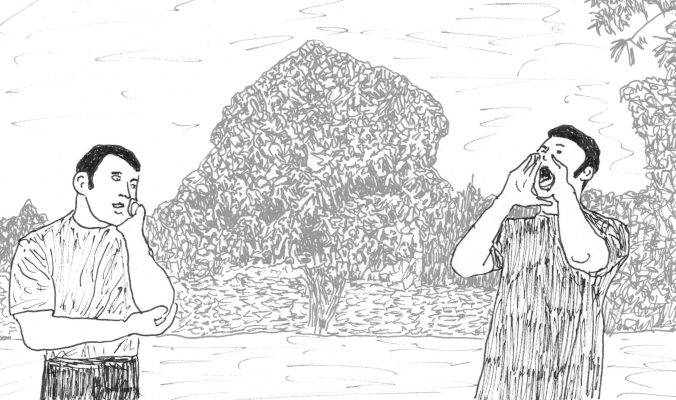 |
(Italiano) Il giorno dopo Heinz sta meglio e si lascia guidare da Helmut e Muriel attraverso il campo di addestramento degli animali, che è più grande di quanto avesse immaginato. Helmut ormai si orienta bene e si è già presentato a tutti gli animali. |
(Deutsch) Am nächsten Tag geht es Heinz wieder besser und er lässt sich von Helmut und Muriel durchs Tiertrainingscamp führen, das größer ist, als er gedacht hat. Helmut kennt sich inzwischen schon gut aus und hat sich allen Tieren bereits vorgestellt. Normal Version | ||
Das Affenhaus Tag 33 1 Helmut: Nun komm doch zu mir! Lass uns über alles sprechen! Bitte komm! |
Day 33 Helmut: Come on, come to me! Let's talk about everything! Please come! |
Jour 33 Helmut : Allez, viens vers moi ! On va tout se dire ! S'il te plaît, viens ! |
Giorno 33 Helmut: Dai, vieni da me! Parliamo di tutto! Per favore, vieni! |
Día 33 Helmut: ¡Venga, ven aquí! ¡Hablemos de todo! ¡Por favor, ven! |
2 Heinz: Naja, erst mal hält sie dich für einen Lügner und Verräter. |
Heinz: Well, for now she thinks you're a liar and a traitor. |
Heinz : Bon, pour l'instant elle te prend pour un menteur et un traître. |
Heinz: Beh, per ora ti considera un bugiardo e un traditore. |
Heinz: Bueno, por ahora te considera un mentiroso y un traidor. |
3 Heinz: Wie jetzt? Du latschst morgens eine Stunde zum Dorf, um mit anderen zusammen zu kacken? |
Heinz: Wait, what? You walk an hour to the village in the morning just to take a dump together with other people? |
Heinz : Attends, quoi ? Tu marches une heure jusqu'au village le matin pour aller chier avec des autres ? |
Heinz: Aspetta, cosa? Vai a piedi un'ora fino al villaggio la mattina per cagare insieme ad altre persone? |
Heinz: Espera, ¿qué? ¿Te pasas una hora caminando hasta el pueblo por la mañana para cagar con otras personas? |
4 Heinz: Und das große, hohe Gebäude da gehört den Affen? Wow. Man kann sie schon von draußen hören. |
Heinz: And that big, tall building over there belongs to the monkeys? Wow. You can already hear them from outside. |
Heinz : Et ce grand bâtiment tout en hauteur, c'est celui des singes ? Waouh. On peut déjà les entendre de dehors. |
Heinz: E quel grande edificio alto appartiene alle scimmie? Wow. Si sentono già da fuori. |
Heinz: ¿Y ese edificio grande y alto de ahí es de los monos? Guau. Ya se les oye desde fuera. |
(English) As the Boys and Aouda are having a chai in front of the main house after the big meeting, they see one of the runaways returning. He gives a report that Heinz can’t really follow, but Helmut and Aouda seem to understand it. |
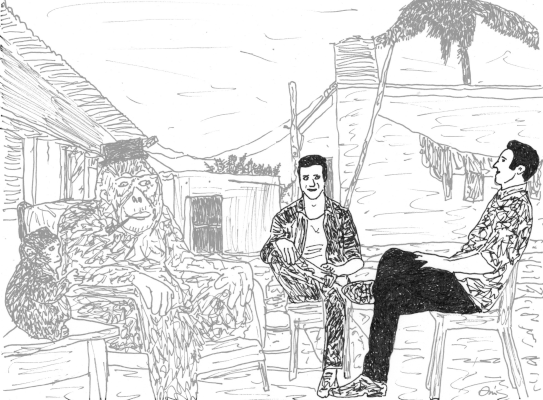 |
(Italiano) Quando i Ragazzi e Aouda bevono un chai davanti alla casa principale dopo la grande riunione, vedono uno dei fuggitivi tornare. Fa un rapporto che Heinz non riesce davvero a seguire, ma Helmut e Aouda sembrano capirlo. |
(Deutsch) Als die Jungs und Aouda nach der großen Besprechung einen Chai vor dem Haupthaus trinken, sehen sie einen der Ausreißer zurückkommen. Er gibt einen Bericht ab, dem Heinz nicht recht folgen kann, aber Helmut und Aouda können es, wie es scheint. Normal Version | ||
Tag 33 1 Heinz: Da kommt unser Chai. Dank dir, setz dich doch zu uns! OK, zu beschäftigt. Verständlich, seit der großen Besprechung vorhin sind alle beunruhigt. Ts, kaum sind wir hier, bricht das Chaos aus. Wenigstens hast du dich wieder mit Udi vertragen. |
Day 33 Heinz: Here comes our chai. Thanks to you, have a seat with us! OK, too busy. Understandable, everyone's been on edge since the big meeting earlier. Tsk, we've barely arrived and chaos breaks out. At least you made up with Oody again. |
Jour 33 Heinz : Voilà notre chai. Merci à toi, viens t'asseoir avec nous ! OK, trop occupé. Compréhensible, depuis la grande réunion tout à l'heure, tout le monde est inquiet. Ts, à peine on est là que le chaos éclate. Au moins, tu t'es réconcilié avec Oudi. |
Giorno 33 Heinz: Ecco il nostro chai. Grazie a te, siediti pure con noi! OK, troppo occupato. Comprensibile, dalla grande riunione di prima tutti sono inquieti. Tsk, siamo appena arrivati e scoppia il caos. Almeno ti sei riconciliato con Udi. |
Día 33 Heinz: Ahí viene nuestro chai. Gracias a ti, ¡siéntate con nosotros! Vale, demasiado ocupado. Comprensible, desde la gran reunión de antes todos están inquietos. Tsk, apenas llegamos y estalla el caos. Al menos te has reconciliado con Udi. |
2 Heinz: Mit diesem Hut erinnert er mich irgendwie an ... |
Heinz: With that hat, he kind of reminds me of… |
Heinz : Avec ce chapeau, il me rappelle un peu... |
Heinz: Con quel cappello mi ricorda in qualche modo... |
Heinz: Con ese sombrero me recuerda de alguna manera a... |
3 Heinz: Er sitzt da wie ein zufriedener Großgrundbesitzer am Ende eines erfolgreichen Tages. Hat er eigentlich keine Fußfessel? Was ...? Hust hust, du hast recht, der Tabak ist grauenhaft. Riecht nach verbrannter Schuhsohle. Hust |
Heinz: He's sitting there like a satisfied landowner at the end of a successful day. Doesn't he have an ankle shackle? What...? Cough cough, you're right, that tobacco is awful. Smells like a burnt shoe sole. Cough |
Heinz : Il est assis là comme un grand propriétaire satisfait à la fin d'une journée réussie. Il n'a pas de chaîne à la cheville ? Quoi... ? Tousse tousse, tu as raison, ce tabac est horrible. Ça sent la semelle brûlée. Tousse |
Heinz: Sta seduto lì come un grande proprietario soddisfatto alla fine di una giornata di successo. Non ha una cavigliera? Che...? Toss toss, hai ragione, quel tabacco è terribile. Sa di suola di scarpa bruciata. Toss |
Heinz: Está sentado ahí como un gran terrateniente satisfecho al final de un día exitoso. ¿No tiene grillete? ¿Qué...? Tos tos, tienes razón, ese tabaco es horrible. Huele a suela de zapato quemada. Tos |
4 Helmut: Er sagt, dass Rupert die anderen Affen tief in den Dschungel des Reservats geführt hat. |
Helmut: He says Rupert led the other monkeys deep into the jungle of the reserve. |
Helmut : Il dit que Rupert a conduit les autres singes profondément dans la jungle de la réserve. |
Helmut: Dice che Rupert ha condotto le altre scimmie in profondità nella giungla della riserva. |
Helmut: Dice que Rupert llevó a los otros monos a lo profundo de la jungla de la reserva. |
(English) While Aouda and Bobo are surveilling the monkeys at the camp and the search for Rupert isn’t making any progress, the next day the Boys, at Helmut’s request, set out toward the ashram, about an hour away on foot, to see Guru Mahirashi. |
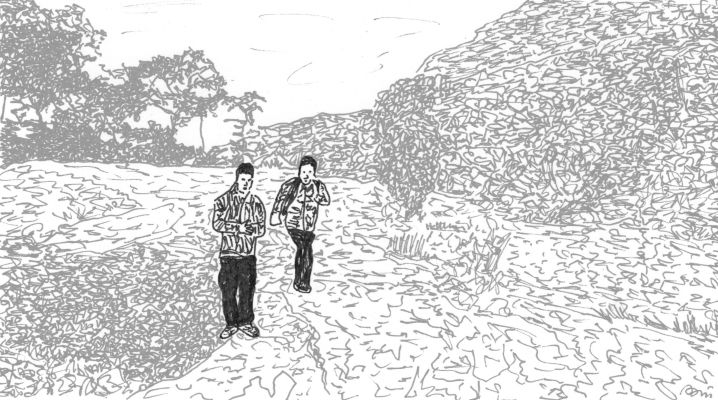 |
(Italiano) Mentre Aouda e Bobo sorvegliano le scimmie al campo e la ricerca di Rupert non fa progressi, il giorno dopo i Ragazzi, su richiesta di Helmut, si incamminano verso l’ashram, a un’ora di distanza a piedi, per vedere il guru Mahirashi. |
(Deutsch) Während Aouda und Bobo im Camp auf die Affen aufpassen und die Suche nach Rupert nicht vorangeht, wandern die Jungs am nächsten Tag auf Helmuts Wunsch hin zum Ashram, der eine Fußstunde entfernt ist, um den Guru Mahirashi zu sehen. Normal Version | ||
Tag 34 1 Heinz: Flatsch! Autsch! Äh, könntest du mit den Zweigen ein bisschen aufpassen, die auf Augenhöhe auf dem Weg sind? |
Day 34 Heinz: Whap! Ouch! Erm, could you be a little more careful with those branches at eye level on the path? |
Jour 34 Heinz : Clac ! Aïe ! Euh, tu pourrais faire un peu attention aux branches à hauteur des yeux sur le chemin ? |
Giorno 34 Heinz: Tac! Ahi! Eh, potresti fare un po' attenzione ai rami all'altezza degli occhi sul sentiero? |
Día 34 Heinz: ¡Zas! ¡Ay! Eh, ¿podrías tener un poco de cuidado con las ramas a la altura de los ojos en el camino? |
2 Heinz: Sag mal, meinst du das ernst? Hier zwischen den Felsen nach oben? |
Heinz: Hey, are you serious? Up here between the rocks? |
Heinz : Dis donc, tu es sérieux ? Monter par là, entre les rochers ? |
Heinz: Ma dai, dici sul serio? Qui tra le rocce, verso l'alto? |
Heinz: Oye, ¿hablas en serio? ¿Por aquí entre las rocas hacia arriba? |
3 Helmut: Die Kletterpartie hat sich gelohnt! Sieh doch! Dort unten irgendwo schwingt Tarzan mit einer Liane umher. Jane!!, schreit er. Wo ist meine Frau? Cheeta, mein treuer Affe, geh und such ... |
Helmut: The climb was worth it! Look! Down there somewhere Tarzan is swinging around on a vine. Jane!! he shouts. Where is my wife? Cheeta, my faithful ape, go and search… |
Helmut : L'escalade en valait la peine ! Regarde ! Quelque part là-bas, Tarzan se balance avec une liane. Jane !!, il crie. Où est ma femme ? Cheeta, mon fidèle singe, va chercher… |
Helmut: La scalata è valsa la pena! Guarda! Laggiù da qualche parte Tarzan si dondola con una liana. Jane!!, grida. Dov'è mia moglie? Cheeta, mia fedele scimmia, vai a cercare… |
Helmut: ¡La escalada ha valido la pena! ¡Mira! Allí abajo, en algún lugar, Tarzán se balancea con una liana. ¡¡Jane!!, grita. ¿Dónde está mi mujer? Cheeta, mi fiel mono, ve a buscar… |
4 Helmut: Weißt du, beim Meditieren hat man leere Phasen zwischen den Gedanken, Bildern und Gefühlen, die unwillkürlich aufploppen. Wenn man trainiert, diese Phasen zu verlängern, kommt man der Sache näher. |
Helmut: You know, when you meditate, there are empty phases between the thoughts, images, and feelings that pop up involuntarily. If you train yourself to extend these phases, you get closer to the thing. |
Helmut : Tu sais, quand on médite, il y a des phases vides entre les pensées, les images et les émotions qui surgissent spontanément. Si on s'entraîne à prolonger ces phases, on se rapproche de la chose. |
Helmut: Sai, durante la meditazione ci sono fasi vuote tra i pensieri, le immagini e le emozioni che emergono spontaneamente. Se ti alleni a prolungare queste fasi, ti avvicini alla cosa. |
Helmut: Sabes, al meditar hay fases vacías entre los pensamientos, imágenes y emociones que surgen involuntariamente. Si entrenas para alargar estas fases, te acercas a la cosa. |
(English) Helmut meditates for a long time. A very long time. When he finally gets up, he’s the only one left from the group. Heinz visits him from time to time and admires his endurance. However, Helmut considers his theory about what happened at the fire to be absurd. |
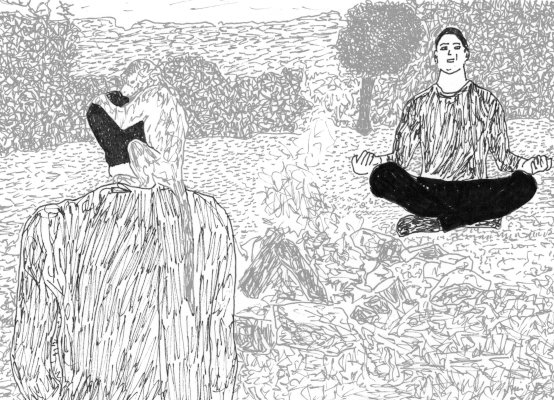 |
(Italiano) Helmut medita a lungo. Molto a lungo. Quando finalmente si alza, è l’unico rimasto del gruppo. Heinz passa ogni tanto a trovarlo e ammira la sua resistenza. Tuttavia, Helmut considera assurda la sua teoria su ciò che è successo attorno al fuoco. |
(Deutsch) Helmut meditiert lange. Sehr lange. Als er endlich aufsteht, ist er als Einziger aus der Gruppe übriggeblieben. Heinz besucht ihn zwischendurch und bewundert seine Ausdauer. Seine Theorie über das, was am Feuer geschehen ist, hält Helmut allerdings für abwegig. Normal Version | ||
Tag 37 1 Heinz: Das gibt's doch nicht! Der sitzt immer noch da. Helmut! Jetzt steht selbst der Mahirashi auf und geht. Wow, der hat also auch drei Tage ausgehalten. |
Day 37 Heinz: You've got to be kidding me! He's still sitting there. Helmut! Now even the Mahirashi is getting up and leaving. Wow, so he lasted three days too. |
Jour 37 Heinz : C'est pas possible ! Il est encore assis là. Helmut ! Maintenant même le Mahirashi se lève et s'en va. Waouh, il a donc tenu trois jours lui aussi. |
Giorno 37 Heinz: Ma non è possibile! È ancora lì seduto. Helmut! Adesso perfino il Mahirashi si alza e se ne va. Wow, quindi ha resistito anche lui tre giorni. |
Día 37 Heinz: ¡No me lo puedo creer! Sigue ahí sentado. ¡Helmut! Ahora incluso el Mahirashi se levanta y se va. Vaya, así que él también aguantó tres días. |
2 Heinz: Sheldon? |
Heinz: Sheldon? |
Heinz : Sheldon ? |
Heinz: Sheldon? |
Heinz: ¿Sheldon? |
3 Helmut: Erzähl mir was Schönes, Mahirashi! Du hast eine Knospe gesehen, die so bezaubernd war, dass du sie nicht gepflückt hast? Sehr gut. |
Helmut: Tell me something beautiful, Mahirashi! You saw a bud so enchanting that you didn't pick it? Very good. |
Helmut : Raconte-moi quelque chose de beau, Mahirashi ! Tu as vu un bourgeon si enchanteur que tu ne l'as pas cueilli ? Très bien. |
Helmut: Raccontami qualcosa di bello, Mahirashi! Hai visto un bocciolo così incantevole da non coglierlo? Molto bene. |
Helmut: ¡Cuéntame algo bonito, Mahirashi! ¿Has visto un capullo tan encantador que no lo has recogido? Muy bien. |
4 Heinz: (Genial! Du zementierst deine Alpha-Position durch einen Schein-Pakt, den er in der Öffentlichkeit nicht ablehnen kann.) |
Heinz: (Brilliant! You're cementing your alpha position through a pseudo-pact he can't refuse in public.) |
Heinz : (Génial ! Tu cimentes ta position alpha avec un pseudo-pacte qu'il ne peut pas refuser en public.) |
Heinz: (Geniale! Cementi la tua posizione alfa con un finto patto che non può rifiutare in pubblico.) |
Heinz: (¡Genial! Estás cimentando tu posición alfa con un pacto aparente que no puede rechazar en público.) |
(English) India. A land of constant change and rebirth. Heinz and Helmut are now right in the middle of it. They recognize connections they hadn’t seen before. And yet, they were always there. Inside is outside, the small is the big, and all is one. |
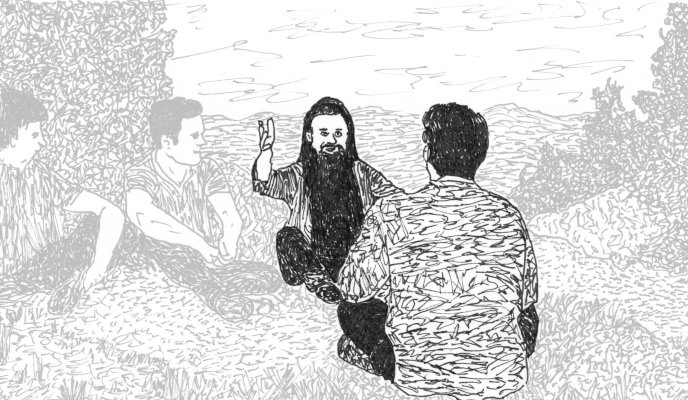 |
(Italiano) L'India. Terra di cambiamento continuo e rinascita. Heinz e Helmut ora sono proprio nel mezzo. Riconoscono connessioni che prima non avevano visto. Eppure sono sempre state lì. L’interno è l’esterno, il piccolo è il grande e tutto è uno. |
(Deutsch) Indien. Land der ständigen Veränderung und Wiedergeburt. Heinz und Helmut sind jetzt mittendrin. Sie erkennen Verbindungen, die sie zuvor nicht gesehen haben. Dabei sind sie schon immer da gewesen. Innen ist außen, das Kleine ist das Große und alles ist eins. Normal Version | ||
Tag 38 1 Heinz: Dann wollen wir mal sehen, wie es unserem Buddha heute geht. Wo steckt er denn? Hm. Ah, da vorne stehen Leute, die ich fragen kann. Ähm, excuse me, have you seen ... Aaaaaaaah!! Helmut! |
Day 38 Heinz: Well, let's see how our Buddha is doing today. Where is he? Hm. Ah, there are people over there I can ask. Uh, "excuse me, have you seen…" Aaaaaaaah!! Helmut! |
Jour 38 Heinz : Alors, voyons voir comment va notre Bouddha aujourd'hui. Où est-ce qu'il est ? Hm. Ah, il y a des gens là-bas que je peux demander. Euh, excuse me, have you seen … Aaaaaaaah !! Helmut ! |
Giorno 38 Heinz: Allora, vediamo un po' come sta oggi il nostro Buddha. Dov'è? Hm. Ah, lì davanti ci sono delle persone a cui posso chiedere. Eh, excuse me, have you seen… Aaaaaaaah!! Helmut! |
Día 38 Heinz: Bueno, veamos cómo está hoy nuestro Buda. ¿Dónde se habrá metido? Hm. Ah, allí delante hay gente a la que puedo preguntar. Eh, excuse me, have you seen… ¡¡Aaaaaaaah!! ¡Helmut! |
2 Heinz: Und wo ist George? Durchlebt er vielleicht grad ein Martyrium oder tötet er Drachen oder so was? |
Heinz: And where's George? Going through some martyrdom right now or slaying dragons or something? |
Heinz : Et George, il est où ? Il vit un martyre ou il tue des dragons ou un truc du genre ? |
Heinz: E George dov'è? Sta passando un martirio o uccide draghi o qualcosa del genere? |
Heinz: ¿Y dónde está George? ¿Está pasando por un martirio o matando dragones o algo así? |
3 Helmut: Öffne deinen Geist und lass alle Gedanken und Gefühle wie Rauch in den klaren Himmel emporsteigen! |
Helmut: Open your mind and let all thoughts and feelings rise like smoke into the clear sky! |
Helmut : Ouvre ton esprit et laisse toutes les pensées et émotions s'élever comme de la fumée dans le ciel clair ! |
Helmut: Apri la tua mente e lascia che tutti i pensieri e le emozioni salgano come fumo nel cielo limpido! |
Helmut: ¡Abre tu mente y deja que todos los pensamientos y sentimientos asciendan como humo hacia el cielo claro! |
4 Helmut: Die autoritäre Gesellschaft war die ganze Zeit über da, wir haben es bloß übersehen. |
Helmut: The authoritarian society was there all along, we just overlooked it. |
Helmut : La société autoritaire était là depuis le début, on ne l'a simplement pas remarquée. |
Helmut: La società autoritaria c'era da sempre, semplicemente non l'abbiamo vista. |
Helmut: La sociedad autoritaria siempre estuvo ahí, solo que no la vimos. |
(English) Let’s take a quick look over at Wiesbaden in the meantime, at Fiona and Fanni’s agency, because something’s happening there. It’s hard to say whether it’s a good development or not, but it all starts with a phone call, that much is certain. |
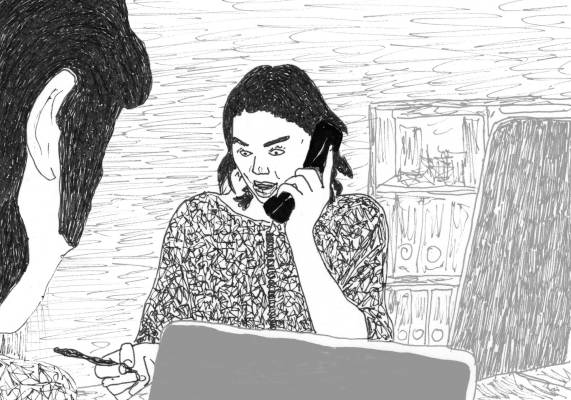 |
(Italiano) Diamo nel frattempo un'occhiata veloce a Wiesbaden, all'agenzia di Fiona e Fanni, perché lì sta succedendo qualcosa. Non è facile dire se si tratti di una svolta positiva o meno, ma di sicuro tutto inizia con una telefonata, questo è certo. |
(Deutsch) Werfen wir zwischendurch einen Seitenblick nach Wiesbaden, auf die Agentur von Fiona und Fanni, denn dort tut sich etwas. Es ist nicht leicht zu sagen, ob es sich um eine gute Entwicklung handelt oder nicht, es beginnt jedenfalls mit einem Telefonat, so viel steht fest. Normal Version | ||
Tag 39 1 Fanni: Nein, Frau ... äh, Piefkemeier, wir können den Gesundheitsservice leider nicht mehr anbieten. Das haben wir der Gräfin von Rauschebach übrigens mitgeteilt. Ich weiß, aber es war nur eine Testphase und wir haben das Projekt neu bewertet. Der Grund? |
Side Effects Day 39 Fanni: No, Frau… uh, Pifflemeyer, unfortunately we can no longer offer the health service. We did inform the Countess von Rauschebach about it, by the way. I know, but it was only a trial phase and we've reassessed the project. The reason? |
Jour 39 Fanni : Non, Frau… euh, Pifmeier, on ne peut malheureusement plus proposer le service de santé. On en a d'ailleurs informé la comtesse de Rauschebach. Je sais, mais c'était seulement une phase de test et on a réévalué le projet. La raison ? |
Giorno 39 Fanni: No, Frau… eh, Pincomeier, purtroppo non possiamo più offrire il servizio sanitario. L'abbiamo già comunicato alla contessa von Rauschebach, tra l'altro. Lo so, ma era solo una fase di prova e abbiamo rivalutato il progetto. Il motivo? |
Día 39 Fanni: No, Frau… eh, Piltrafameier, lamentablemente ya no podemos ofrecer el servicio de salud. Por cierto, también se lo hemos comunicado a la condesa von Rauschebach. Lo sé, pero solo era una fase de prueba y hemos reevaluado el proyecto. ¿La razón? |
2 Fanni: Na? Ja, genau, Sven. Der Schluckauf ist weg. Nach einer vollen Woche. Halleluja! |
Fanni: Well? Yes, exactly, Sven. The hiccups are gone. After a full week. Hallelujah! |
Fanni : Alors ? Oui, exactement, Sven. Le hoquet a disparu. Après une semaine entière. Alléluia ! |
Fanni: Allora? Sì, esatto, Sven. Il singhiozzo è sparito. Dopo un'intera settimana. Alleluia! |
Fanni: ¿Y bien? Sí, exactamente, Sven. El hipo ha desaparecido. Después de una semana entera. ¡Aleluya! |
3 Fanni: Ich HABE es dir vorher gesagt. Als du gestern Morgen auf dem Parkplatz in Jennys Wagen reingefahren bist, zum Beispiel. |
Fanni: I DID tell you beforehand. When you crashed into Jenny's car in the parking lot yesterday morning, for example. |
Fanni : Je te l'AI dit avant. Par exemple, quand tu es rentrée dans la voiture de Jenny hier matin sur le parking. |
Fanni: Te l'ho DETTO prima. Per esempio quando ieri mattina sei andata a sbattere contro la macchina di Jenny nel parcheggio. |
Fanni: ¡Te lo DIJE antes! Por ejemplo, cuando ayer por la mañana chocaste contra el coche de Jenny en el aparcamiento. |
4 Fanni: Naja ... |
Fanni: Well… |
Fanni : Eh bien… |
Fanni: Beh… |
Fanni: Bueno… |
(English) Heinz and Helmut find themselves sitting opposite each other in Heinz’s bathtub. Helmut is trying out a bath additive, while Heinz needs more hot water. He repeatedly insists on his domestic authority, but listens carefully to what his friend has to say. |
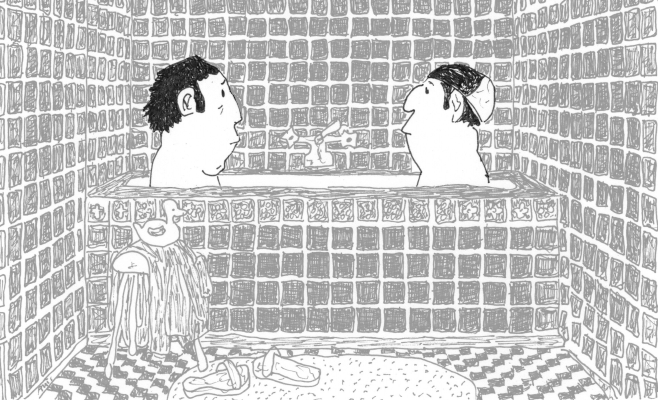 |
(Italiano) Heinz e Helmut si ritrovano seduti uno di fronte all’altro nella vasca da bagno di Heinz. Helmut prova un additivo da bagno, mentre Heinz ha bisogno di più acqua calda. Ribadisce più volte il suo diritto di casa, ma ascolta attentamente ciò che il suo amico ha da dirgli. |
(Deutsch) Heinz und Helmut finden sich einander gegenüber sitzend in Heinz' Badewanne wieder. Helmut probiert einen Badezusatz aus, während Heinz mehr heißes Wasser braucht. Er pocht mehrfach auf sein Hausrecht, hört aber genau zu, was sein Freund ihm zu sagen hat. Normal Version | ||
Tag 39 1 Helmut: Ja, so gefällt es Papa! Aaaah, räkel. Vielleicht eine Idee mehr kaltes Wasser. |
Day 39 Helmut: Yeah, that's just how Daddy likes it! Aaaah, stretch. Maybe a bit more cold water. |
Jour 39 Helmut : Oui, c'est comme ça que papa aime ça ! Aaaah, étire. Peut-être un peu plus d'eau froide. |
Giorno 39 Helmut: Sì, così piace a papà! Aaaah, stiracc. Forse un po' più di acqua fredda. |
En la bañera Día 39 Helmut: Sí, ¡así le gusta a papá! Aaaah, qué bien se estira. Quizá un poco más de agua fría. |
2 Heinz: Du hast mich damit gezwungen, das Wasser abzustellen. Das ist Nötigung! |
Heinz: You forced me to turn off the water with this action. That's coercion! |
Heinz : Tu m'as forcé à couper l'eau avec ce coup-là. C'est de la contrainte ! |
Heinz: Mi hai costretto a chiudere l'acqua. È coercizione! |
Heinz: Me has obligado a cerrar el agua con esta acción. ¡Eso es coacción! |
3 Helmut: Hier ist noch was: § 140 Strafgesetzbuch. Wer öffentlich schwere Straftaten wie Völkermord, Angriffskriege oder das Zerstören von Krankenhäusern befürwortet, lobt oder gutheißt, wird bestraft. |
Helmut: Here's another one: Section 140 of the Criminal Code. Anyone who publicly endorses, praises, or approves serious crimes like genocide, wars of aggression, or destroying hospitals is punishable. |
Helmut : Et encore ceci : l'article 140 du code pénal. Celui qui approuve, loue ou cautionne publiquement des crimes graves comme le génocide, les guerres d'agression ou la destruction d'hôpitaux est puni. |
Helmut: Ecco un'altra cosa: § 140 del codice penale. Chi approva, elogia o giustifica pubblicamente gravi reati come genocidio, guerre di aggressione o la distruzione di ospedali, viene punito. |
Helmut: Y otra cosa: § 140 del código penal. Quien apruebe, elogie o justifique públicamente delitos graves como genocidio, guerras de agresión o la destrucción de hospitales será castigado. |
4 Heinz: Die Ente bleibt draußen! |
Heinz: The duck stays out! |
Heinz : Le canard reste dehors ! |
Heinz: L'anatra resta fuori! |
Heinz: ¡El pato se queda fuera! |
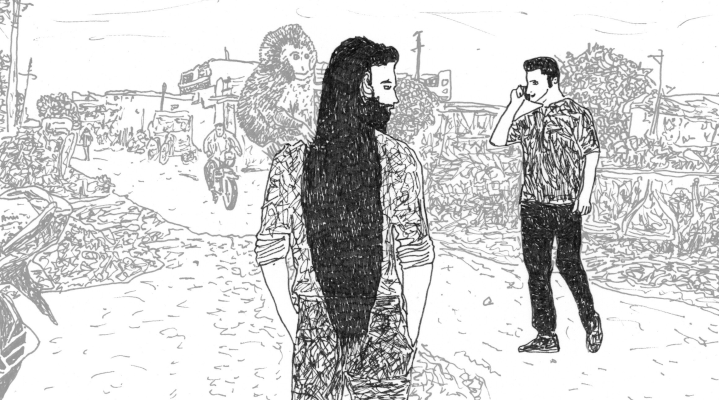
(English) Helmut should really understand that Heinz is turning to him to interpret his dream, but he shows no interest. Together with Aouda, the two pass the time in the village while they wait for Chinmay, a friend of the camp and its animals. |
 |
(Italiano) Helmut dovrebbe in realtà capire che Heinz si rivolge a lui per interpretare il suo sogno, ma si mostra disinteressato. Insieme ad Aouda, i due passano il tempo nel villaggio mentre aspettano Chinmay, un amico del campo e dei suoi animali. |
(Deutsch) Helmut sollte eigentlich verstehen, dass Heinz sich an ihn wendet, um seinen Traum zu deuten, aber er zeigt sich desinteressiert. Gemeinsam mit Aouda vertreiben sich die beiden im Dorf die Zeit, während sie auf Chinmay warten, einen Freund des Camps und seiner Tiere. Normal Version | ||
Tag 39 1 Heinz: Ach Quatsch, wir haben alle mal solche Aussetzer! Ich könnte dir Sachen erzählen! Naja, das mach ich, wenn ich wieder zu Hause bin. |
Day 39 Heinz: Oh come on, we all have slip-ups like that sometimes! I could tell you stories! Well, I'll do that when I'm back home. |
Jour 39 Heinz : Mais non, ça nous arrive à tous d'avoir des absences comme ça ! Je pourrais t'en raconter ! Bon, je le ferai quand je serai de retour à la maison. |
Giorno 39 Heinz: Ma dai, a tutti capita di avere qualche svista! Potrei raccontarti certe cose! Vabbè, lo farò quando sarò tornato a casa. |
Día 39 Heinz: ¡Venga ya, a todos nos pasan meteduras de pata como esa! ¡Podría contarte cosas! Bueno, lo haré cuando vuelva a casa. |
2 Heinz: Nein, das hast du gesagt. „Erinnerst du dich nicht?” Zu mir. Du warst der Weihnachtsmann mit einem Rauschebart und hast mir Tipps gegeben. Der ganze Traum war voller Hinweise. |
Heinz: No, that's what you said. "Don't you remember?" To me. You were Santa Claus with a bushy beard and gave me tips. The whole dream was full of clues. |
Heinz : Non, c'est ce que tu as dit. « Tu ne te souviens pas ? » À moi. Tu étais le Père Noël avec une grande barbe et tu m'as donné des conseils. Tout le rêve était plein d'indices. |
Heinz: No, l'hai detto tu. "Non ti ricordi?" A me. Eri Babbo Natale con una barba folta e mi davi consigli. Tutto il sogno era pieno di indizi. |
Heinz: No, eso lo dijiste tú. "¿No lo acuerdas?" A mí. Eras Papá Noel con una barba espesa y me dabas consejos. Todo el sueño estaba lleno de pistas. |
3 Helmut: Hm. Ich glaub, das liegt an dir. Als du da hinten standst, hat mich niemand angegrabbelt. |
Helmut: Hm. I think it's because of you. When you were standing back there, nobody grabbed me. |
Helmut : Hm. Je crois que c'est à cause de toi. Quand tu étais là-bas, personne ne m'a tripoté. |
Helmut: Hm. Credo che sia colpa tua. Quando stavi laggiù, nessuno mi toccava. |
Helmut: Hm. Creo que es por tu culpa. Cuando estabas allí atrás, nadie me manoseaba. |
4 Helmut: Das ist dein Ding, was? Sachen analysieren. Träume, Bücher, Songs, Situationen ... Aber übertreib es nicht! Letztlich sind Analysen Abstraktionen. |
Helmut: That's your thing, right? Analyzing stuff. Dreams, books, songs, situations… But don't overdo it! In the end, analyses are abstractions. |
Helmut : C'est ton truc, hein ? Analyser les choses. Les rêves, les livres, les chansons, les situations… Mais n'exagère pas ! Au final, les analyses sont des abstractions. |
Helmut: È la tua cosa, eh? Analizzare tutto. Sogni, libri, canzoni, situazioni… Ma non esagerare! Alla fine, le analisi sono astrazioni. |
Helmut: Ese es tu rollo, ¿no? Analizar cosas. Sueños, libros, canciones, situaciones… ¡Pero no exageres! Al final, los análisis son abstracciones. |
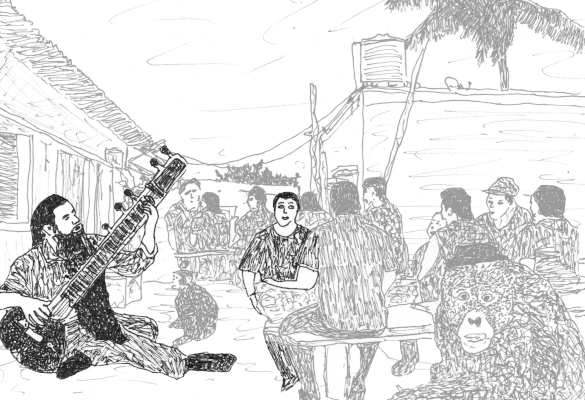
(English) After informing the people at the animal camp about Chinmay’s report, Helmut gets himself into an embarrassing situation and picks up the sitar that is handed to him. Heinz makes fun of his friend, but the laughter soon catches in his throat. |
 |
(Italiano) Dopo aver informato la gente del campo animale del resoconto di Chinmay, Helmut si mette in una situazione imbarazzante e prende il sitar che gli viene passato. Heinz prende in giro il suo amico, ma gli si strozza presto la risata in gola. |
(Deutsch) Nachdem sie die Leute im Tier-Camp von Chinmays Bericht in Kenntnis gesetzt haben, bringt sich Helmut in eine peinliche Situation und nimmt die Sitar zur Hand, die ihm gereicht wird. Heinz macht sich über seinen Freund lustig, doch bleibt ihm das Lachen im Halse stecken. Normal Version | ||
Tag 39 1 Helmut: Ah, da sitzen ja alle vor dem Haus. Hi Muriel, Ranjid und alle! Hört mal, wir waren gerade im Dorf und Chinmay hat uns erzählt, dass Rupert ihn heute angegriffen hat. Chinmay hat ihn und seine Gang im Wald aufgestöbert. Äh, was ist los? |
Day 39 Helmut: Ah, looks like everyone's sitting in front of the house. Hi Muriel, Ranjid, everyone! Listen, we were just in the village and Chinmay told us that Rupert attacked him today. Chinmay tracked him and his gang down in the forest. Uh, what's going on? |
Jour 39 Helmut : Ah, tout le monde est assis devant la maison. Salut Muriel, Ranjid et tout le monde ! Écoutez, on revient du village et Chinmay nous a dit que Rupert l'a attaqué aujourd'hui. Chinmay l'a retrouvé, lui et sa bande, dans la forêt. Euh, qu'est-ce qui se passe ? |
Giorno 39 Helmut: Ah, sono tutti seduti davanti alla casa. Ciao Muriel, Ranjid e tutti! Ascoltate, siamo appena stati al villaggio e Chinmay ci ha raccontato che Rupert lo ha attaccato oggi. Chinmay ha rintracciato lui e la sua banda nella foresta. Eh, che succede? |
Día 39 Helmut: Ah, todos están sentados delante de la casa. ¡Hola Muriel, Ranjid y todos! Escuchad, acabamos de estar en el pueblo y Chinmay nos ha contado que Rupert lo ha atacado hoy. Chinmay lo localizó a él y a su banda en el bosque. Eh, ¿qué pasa? |
2 Helmut: Ja, Aouda, ich weiß, dass du zu ihm willst, aber es wird schon dunkel. Deshalb sitzen wir ja hier. Um das zu besprechen. |
Helmut: Yeah. Aouda, I know you want to go to him, but it's getting dark. That's why we're sitting here. To discuss it. |
Helmut : Oui. Aouda, je sais que tu veux aller le voir, mais il fait déjà sombre. C'est pour ça qu'on est assis ici. Pour en parler. |
Helmut: Sì. Aouda, so che vuoi andare da lui, ma sta facendo buio. È per questo che siamo seduti qui. Per parlarne. |
Helmut: Sí. Aouda, sé que quieres ir a verlo, pero ya está oscureciendo. Por eso estamos sentados aquí. Para hablar de eso. |
3 Heinz: Tja, Helmut, wer sich einen langen Bart wachsen lässt und Weisheit verteilt wie Kamellen auf dem Mainzer Karneval, darf sich über solche Reaktionen nicht wundern, hihi. Dann zeig mal, was du kannst! (Hihi.) |
Heinz: Well, Helmut, if you grow a long beard and dish out wisdom like candy at the Mainz carnival, you shouldn't be surprised by reactions like this, hehe. So let's see what you've got! (Hehe.) |
Heinz : Eh bien, Helmut, quand on se laisse pousser une longue barbe et qu'on distribue de la sagesse comme des bonbons au carnaval de Mayence, il ne faut pas s'étonner de ce genre de réactions, hihi. Alors montre ce que tu sais faire ! (Hihi.) |
Heinz: Beh, Helmut, chi si fa crescere una lunga barba e distribuisce saggezza come caramelle al carnevale di Magonza non deve stupirsi di reazioni del genere, hihi. Allora facci vedere cosa sai fare! (Hihi.) |
Heinz: Bueno, Helmut, quien se deja crecer una barba larga y reparte sabiduría como caramelos en el carnaval de Maguncia no debería sorprenderse de reacciones así, jaja. ¡A ver qué sabes hacer! (Jaja.) |
4 Helmut: Ach was! Ich setz mich am besten auf den Boden mit dem Gerät. Wo ist denn ... Kchchch. Oh, sorry, das war die Hauswand. Äh, nichts passiert. Die Sitar gehört George? Gut, ich werd es ihm später erklären. Das ist nur ein minimaler Kratzer. So. Ähem. Kchchch, verdammt, schon wieder! |
Helmut: Oh come on! I'd better sit on the floor with the thing. Where is... Kkhkhkh. Oh, sorry, that was the wall. Uh, nothing happened. The sitar belongs to George? Right, I'll explain it to him later. That's just a minimal scratch. So. Ahem. Kkhkhkh, damn it, again! |
Helmut : Oh allez ! Je ferais mieux de m'asseoir par terre avec l'engin. Où est... Kkhkhkh. Oh, désolé, c'était le mur. Euh, rien de grave. Le sitar appartient à George ? D'accord, je lui expliquerai plus tard. Ce n'est qu'une égratignure minime. Bon. Ahem. Kkhkhkh, zut, encore ! |
Helmut: Ma dai! Meglio che mi sieda per terra con l'aggeggio. Dov'è... Kkhkhkh. Oh, scusa, era il muro. Eh, niente di grave. Il sitar appartiene a George? Bene, glielo spiegherò più tardi. È solo un graffio minimo. Ecco. Ehm. Kkhkhkh, dannazione, di nuovo! |
Helmut: ¡Qué va! Mejor me siento en el suelo con el aparato. ¿Dónde está...? Kkhkhkh. Oh, perdón, fue la pared. Eh, no ha pasado nada. ¿El sitar es de George? Bien, se lo explicaré luego. Es solo un rasguño mínimo. Bien. Ejem. Kkhkhkh, ¡maldita sea, otra vez! |
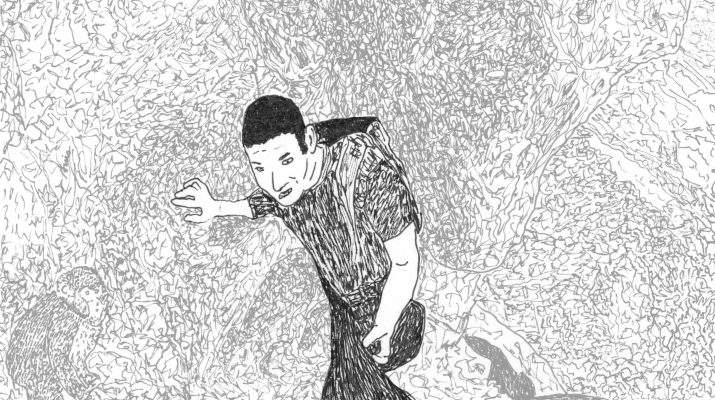
(English) Now that they know Rupert’s approximate whereabouts, nothing is holding Aouda back anymore, and together with her friends she sets out into the jungles of Maharashtra to search for him. She is confident she will find her wayward husband. |
 |
(Italiano) Ora che conoscono l’ubicazione approssimativa di Rupert, nulla trattiene più Aouda e lei si mette alla sua ricerca insieme ai suoi amici nella giungla del Maharashtra. È sicura di ritrovare il suo marito ribelle. |
(Deutsch) Nun, da sie Ruperts ungefähren Aufenthaltsort kennen, hält Aouda nichts mehr auf und sie macht sich zusammen mit ihren Freunden im Dschungel von Maharashtra auf die Suche nach ihm. Sie ist zuversichtlich, ihren abtrünnigen Mann zu finden. Normal Version | ||
Tag 40 1 Heinz: Klatsch! Verdammte Mücken! Oh, da geht es schon wieder einen Felsen rauf. Ist das unser ...? Äh, Helmut? |
Day 40 Heinz: Smack! Damn mosquitoes! Oh, there's another rock to climb. Is that our…? Uh, Helmut? |
L'Expédition Jour 40 Heinz : Paf ! Maudits moustiques ! Oh, ça recommence, encore un rocher à grimper. C'est notre… ? Euh, Helmut ? |
Giorno 40 Heinz: Schiaff! Dannate zanzare! Oh, c'è un'altra roccia da scalare. È il nostro…? Eh, Helmut? |
Día 40 Heinz: ¡Paf! ¡Malditos mosquitos! Oh, hay otra roca que escalar. ¿Es ese nuestro…? Eh, ¿Helmut? |
2 Heinz: In Kuba sterben Babys in Brutkästen, weil kein Strom da ist. Jetzt, wo Gaza keine Konsequenzen hatte, weitet das Imperium den Radius aus. |
Heinz: In Cuba, babies are dying in incubators because there's no electricity. Now that Gaza had no consequences, the empire is expanding its radius. |
Heinz : À Cuba, des bébés meurent dans des couveuses parce qu'il n'y a pas d'électricité. Maintenant que Gaza n'a eu aucune conséquence, l'empire élargit son rayon d'action. |
Heinz: A Cuba i bambini muoiono negli incubatori perché non c'è elettricità. Ora che Gaza non ha avuto conseguenze, l'impero allarga il raggio d'azione. |
Heinz: En Cuba, los bebés mueren en incubadoras porque no hay electricidad. Ahora que Gaza no ha tenido consecuencias, el imperio amplía su radio de acción. |
3 Heinz: Pfl. OK, Rapunzel, wenn du meinst. Hm, bisschen speckig, das Ding. Ich wickel mir den Bart einfach um die Hand, dann kann ich nicht abrutschen. |
Heinz: Pfl. OK, Rapunzel, if you say so. Hm, kind of greasy, that thing. I'll just wrap the beard around my hand so I can't slip. |
Heinz : Pfl. OK, Raiponce, si tu le dis. Hm, un peu graisseux, ce truc. Je vais enrouler la barbe autour de ma main, comme ça je ne glisse pas. |
Heinz: Pfl. Ok, Raperonzolo, se lo dici tu. Hm, è un po' unta, quella cosa. Mi avvolgo la barba intorno alla mano, così non scivolo. |
Heinz: Pfl. Vale, Rapunzel, si tú lo dices. Hm, un poco grasienta, esta cosa. Me enrollo la barba en la mano para no resbalar. |
4 Heinz: Ächz, OK, danke. Hm, ich seh nix. Sind wir denn schon so nah an Ruperts Versteck? Ich dachte, es fehlen noch zwei oder drei Kilometer. |
Heinz: Ugh, OK, thanks. Hm, I can't see anything. Are we already that close to Rupert's hideout? I thought we still had two or three kilometers to go. |
Heinz : Ouf, OK, merci. Hm, je ne vois rien. On est déjà si proches de la cachette de Rupert ? Je pensais qu'il restait encore deux ou trois kilomètres. |
Heinz: Uffa, OK, grazie. Hm, non vedo niente. Siamo già così vicini al nascondiglio di Rupert? Pensavo mancassero ancora due o tre chilometri. |
Heinz: Uf, vale, gracias. Hm, no veo nada. ¿Ya estamos tan cerca del escondite de Rupert? Pensaba que aún faltaban dos o tres kilómetros. |
(English) The group finds themselves in Rupert’s robbers’ cave. Heinz, Helmut, Muriel, Ranjid, Bobo, and the monkey gang witness the complex communication between Aouda and her husband. Is King Rupert just showing off, or is there more behind it? |
 |
(Italiano) Il gruppo si ritrova nella caverna dei briganti di Rupert. Heinz, Helmut, Muriel, Ranjid, Bobo e la banda di scimmie assistono alla complessa comunicazione tra Aouda e suo marito. Re Rupert si sta solo vantando oppure c’è qualcosa di più dietro tutto questo? |
(Deutsch) Die Gruppe findet sich in Ruperts Räuberhöhle wieder. Heinz, Helmut, Muriel, Ranjid, Bobo und die Affenbande werden Zeugen der komplexen Kommunikation zwischen Aouda und ihrem Mann. Gibt König Rupert nur an oder steckt mehr dahinter? Normal Version | ||
König Rupert Tag 40 1 Helmut: Diese aufdringlichen Gibbons sollen ihre Stöcke aus meinem Bart nehmen! Woher kommen die überhaupt? Sie sind nicht aus dem Camp und heimisch sind sie hier auch nicht. |
King Rupert Day 40 Helmut: These pushy gibbons need to get their sticks out of my beard! Where did they even come from? They're not from the camp, and they're not native here either. |
Roi Rupert Jour 40 Helmut : Ces gibbons envahissants devraient enlever leurs bâtons de ma barbe ! D'où est-ce qu'ils sortent, au juste ? Ils ne viennent pas du camp et ils ne sont pas d'ici non plus. |
Re Rupert Giorno 40 Helmut: Questi gibboni invadenti dovrebbero togliere i loro bastoni dalla mia barba! Da dove saltano fuori, poi? Non vengono dal campo e qui non sono nemmeno autoctoni. |
Rey Rupert Día 40 Helmut: ¡Que esos gibones tan pesados me quiten los palos de la barba! ¿De dónde salen siquiera? No son del campamento y aquí tampoco son autóctonos. |
2 Helmut: Ich seh es. Bobo ist endlich zur Seite gegangen. Was für ein Durcheinander! Das sind inzwischen schon mehr als fünfzig Tiere. Muriel, was denkst du darüber? Ja, Rupert hat sich stark verändert. |
Helmut: I see it. Bobo finally moved aside. What a jumble! There must be more than fifty animals by now. Muriel, what do you think about this? Yeah, Rupert has changed a lot. |
Helmut : Je le vois. Bobo s'est enfin poussé. Quel bazar ! Il y a déjà plus de cinquante animaux. Muriel, qu'est-ce que tu en penses ? Oui, Rupert a beaucoup changé. |
Helmut: Lo vedo. Bobo finalmente si è spostato. Che confusione! Ormai ci sono più di cinquanta animali. Muriel, tu che ne pensi? Già, Rupert è cambiato molto. |
Helmut: Lo veo. Bobo por fin se ha apartado. ¡Qué lío! Ya hay más de cincuenta animales. Muriel, ¿qué piensas de esto? Sí, Rupert ha cambiado mucho. |
3 Heinz: Wir müssen irgendwie weiterkommen. Rupert, lass uns frei! Wir bitten dich darum. |
Heinz: We've got to make some progress somehow. Rupert, let us go! We ask you for it. |
Heinz : Il faut qu'on avance d'une manière ou d'une autre. Rupert, libère-nous ! On te le demande. |
Heinz: Dobbiamo andare avanti in qualche modo. Rupert, lasciaci liberi! Te lo chiediamo. |
Heinz: Tenemos que avanzar de alguna manera. Rupert, ¡déjanos libres! Te lo pedimos. |
4 Helmut: Moment noch. Er will Udi irgendwas sagen, aber sie versteht es nicht. |
Helmut: Hold on. He's trying to tell Oody something, but she doesn't understand. |
Helmut : Attends. Il veut dire quelque chose à Oudi, mais elle ne comprend pas. |
Helmut: Ancora un momento. Vuole dire qualcosa a Udi, ma lei non lo capisce. |
Helmut: Un momento. Quiere decirle algo a Udi, pero ella no lo entiende. |
(English) Helmut has returned to the ashram to regain his balance through meditation. When Heinz visits him, he has an urgent concern, and although he doesn’t behave very kindly, Helmut helps him get moving in the right direction. Yep, that’s our Helmut! |
 |
(Italiano) Helmut è tornato all’ashram per ritrovare il suo equilibrio attraverso la meditazione. Quando Heinz gli fa visita, ha una questione urgente, e anche se non si comporta in modo molto amichevole, Helmut lo aiuta a fare un passo avanti. Già, è fatto così, il nostro Helmut! |
(Deutsch) Helmut ist in den Ashram zurückgekehrt, um durch Meditation seine Balance wiederzufinden. Als Heinz ihn besucht, hat er ein dringendes Anliegen, und obwohl er sich nicht sehr freundlich verhält, hilft Helmut ihm auf die Sprünge. Ja, so ist er, unser Helmut! Normal Version | ||
Tag 43 1 Helmut: Ommm |
Day 43 Helmut: Ommm |
Jour 43 Helmut : Ommm |
Giorno 43 Helmut: Ommm |
Día 43 Helmut: Ommm |
2 Heinz: Muriel war sich sicher. Diesen Orange-Ton gibt es sonst nirgends, sagt sie. Aber es ergibt keinen Sinn. Was ist eigentlich mit John, Paul und George? Begleiten sie dich heute nicht? |
Heinz: Muriel was sure. That shade of orange doesn't exist anywhere else, she says. But it doesn't make sense. Anyway, what about John, Paul, and George? Aren't they joining you today? |
Heinz : Muriel en était sûre. Cette nuance d'orange n'existe nulle part ailleurs, dit-elle. Mais ça n'a aucun sens. Et John, Paul et George, d'ailleurs ? Ils ne t'accompagnent pas aujourd'hui ? |
Heinz: Muriel ne era sicura. Quel tono d'arancione non esiste da nessun'altra parte, dice. Ma non ha senso. E John, Paul e George? Non ti accompagnano oggi? |
Heinz: Muriel estaba segura. Ese tono naranja no existe en ninguna otra parte, dice ella. Pero no tiene sentido. ¿Y qué pasa con John, Paul y George? ¿No te acompañan hoy? |
3 Heinz: Eigentlich trifft es sich ganz gut, dass du wieder ausgeruht bist und wir alleine sind. Bereit für eine neue tiefschürfende Wahrheit? Na? Na? |
Heinz: Actually, it works out perfectly that you're well-rested again and we're alone. Ready for a new profound truth? Huh? Huh? |
Heinz : En fait, ça tombe très bien que tu sois reposé et qu'on soit seuls. Prêt pour une nouvelle vérité profonde ? Hein ? Hein ? |
Heinz: In realtà è perfetto che tu sia di nuovo riposato e che siamo soli. Pronto per una nuova verità profonda? Eh? Eh? |
Heinz: En realidad viene muy bien que estés descansado otra vez y que estemos solos. ¿Listo para una nueva verdad profunda? ¿Eh? ¿Eh? |
4 Helmut: Ah, Phase 1: Leugnen. |
Helmut: Ah, phase 1: Denial. |
Helmut : Ah, phase 1 : la négation. |
Helmut: Ah, fase 1: negazione. |
Helmut: Ah, fase 1: negación. |
(English) When Heinz visits his friend again two days later, he finds him doing yoga. He joins the group and tells Helmut about the gloomy premonitions that have been on his mind lately. Helmut also has nothing good to report. |
 |
(Italiano) Quando Heinz visita di nuovo il suo amico due giorni dopo, lo trova mentre fa yoga. Si unisce al gruppo e racconta a Helmut i cupi presentimenti che lo hanno turbato ultimamente. Anche Helmut non ha nulla di buono da raccontare. |
(Deutsch) Als Heinz seinen Freund zwei Tage später erneut besucht, trifft er ihn beim Yoga an. Er schließt sich der Gruppe an und erzählt Helmut von den düsteren Vorahnungen, die ihn in letzter Zeit bewegt haben. Helmut hat ebenfalls nichts Gutes zu berichten. Normal Version | ||
Tag 45 1 Helmut: Ah, der Weisheitssucher ist wieder da! Willkommen im Ashram, Bruder! |
Day 45 Helmut: Ah, the seeker of wisdom is back! Welcome to the ashram, brother! |
Jour 45 Helmut : Ah, le chercheur de sagesse est de retour ! Bienvenue à l'ashram, frère ! |
Giorno 45 Helmut: Ah, il cercatore di saggezza è tornato! Benvenuto nell'ashram, fratello! |
Día 45 Helmut: ¡Ah, el buscador de sabiduría ha vuelto! ¡Bienvenido al ashram, hermano! |
2 Helmut: Die Arme nach oben recken und leicht im Kreis bewegen. Schön die Schultermuskeln einbeziehen. |
Helmut: Stretch your arms up and move them in gentle circles. Make sure to get those shoulder muscles involved. |
Helmut : Lève les bras et fais-les tourner légèrement en cercle. Fais bien travailler les muscles des épaules. |
Helmut: Alza le braccia e muovile in cerchio lentamente. Coinvolgi bene i muscoli delle spalle. |
Helmut: Levanta los brazos y muévelos en círculos suaves. Involucra bien los músculos de los hombros. |
3 Heinz: Wir könnten Ärger bekommen. Der Gruppenzwang wird enorm werden. Vielleicht verlieren wir unsere Bankkarten wie Francesca Albanese, Hüseyin Doğru und die Richter, die gegen Netanjahu vorgehen. Wir könnten aus diversen Gruppen rausfliegen und ... |
Heinz: We could get into trouble. The peer pressure will be enormous. Maybe we'll lose our bank cards like Francesca Albanese, Hüseyin Doğru, and the judges going after Netanyahu. We might get kicked out of various groups and... |
Heinz : On pourrait avoir des ennuis. La pression du groupe va être énorme. On perdra peut-être nos cartes bancaires comme Francesca Albanese, Hüseyin Doğru et les juges qui s'en prennent à Netanyahou. On pourrait se faire exclure de divers groupes et… |
Heinz: Potremmo avere problemi. La pressione del gruppo sarà enorme. Forse perderemo le nostre carte bancarie come Francesca Albanese, Hüseyin Doğru e i giudici che agiscono contro Netanyahu. Potremmo essere espulsi da vari gruppi e... |
Heinz: Podríamos meternos en líos. La presión del grupo será enorme. Quizá perdamos nuestras tarjetas bancarias como Francesca Albanese, Hüseyin Doğru y los jueces que actúan contra Netanyahu. Podríamos ser expulsados de varios grupos y... |
4 Heinz: Hast du hier die ganze Zeit drin geschlafen? In dem kleinen ... Ding? |
Heinz: Have you been sleeping in there the whole time? In that little... thing? |
Heinz : Tu as dormi là-dedans tout ce temps ? Dans ce petit... truc ? |
Heinz: Hai dormito lì dentro per tutto questo tempo? In quel piccolo... coso? |
Heinz: ¿Has dormido ahí dentro todo este tiempo? ¿En ese pequeño... cosa? |
(English) Heinz is sitting with the others in front of the camp’s main house when Helmut appears with Chinmay. But before they can enjoy a cup of chai together, screams coming from the direction of the monkey house startle them. |
 |
(Italiano) Heinz è seduto con gli altri davanti all’edificio principale del campo quando Helmut arriva con Chinmay. Ma prima che possano gustarsi insieme una tazza di chai, vengono allarmati da urla provenienti dalla casa delle scimmie. |
(Deutsch) Heinz sitzt mit den anderen vor dem Haupthaus des Camps, als Helmut mit Chinmay erscheint. Bevor sie aber gemeinsam eine Tasse Chai genießen können, werden sie von Schreien aufgeschreckt, die aus der Richtung des Affenhauses kommen. Normal Version | ||
Tag 47 1 Heinz: Muriel? Wer war denn das, Polizei? Ach so, Beamte vom Naturschutzgebiet. Ist denn schon wieder was passiert? Nicht. Zum Glück. Ah, da kommt Helmut mit Chinmay. |
Day 47 Heinz: Muriel? Who was that, the police? Oh, I see, officers from the wildlife reserve. Did something happen again? No? Thank God. Ah, here comes Helmut with Chinmay. |
Jour 47 Heinz : Muriel ? C'était qui, la police ? Ah, je vois, des agents de la réserve naturelle. Il s'est encore passé quelque chose ? Non ? Heureusement. Ah, voilà Helmut avec Chinmay. |
Giorno 47 Heinz: Muriel? Chi era, la polizia? Ah, capisco, agenti della riserva naturale. È successo di nuovo qualcosa? No? Per fortuna. Ah, ecco che arrivano Helmut e Chinmay. |
Día 47 Heinz: ¿Muriel? ¿Quién era, la policía? Ah, ya veo, agentes de la reserva natural. ¿Ha vuelto a pasar algo? ¿No? Menos mal. Ah, ahí viene Helmut con Chinmay. |
2 Helmut: Das kommt vom Affenhaus. Hoffentlich kein neuer Angriff! Äh, Heinz, warum hast du den Stock aufgehoben? |
Helmut: It's coming from the monkey house. Hopefully not another attack! Erm, Heinz, why did you pick up that stick? |
Helmut : Ça vient de la maison des singes. Espérons que ce ne soit pas une nouvelle attaque ! Euh, Heinz, pourquoi t'as ramassé ce bâton ? |
Helmut: Viene dalla casa delle scimmie. Speriamo non sia un altro attacco! Ehm, Heinz, perché hai raccolto quel bastone? |
Helmut: Viene de la casa de los monos. ¡Espero que no sea otro ataque! Eh, Heinz, ¿por qué has cogido ese palo? |
3 Helmut: Ich hab noch nie so traurige Gorillas und Bonobos gesehen. Sie schlagen sich selbst auf den Kopf, schreien und drehen sich auf dem Boden. Wahrscheinlich hat Udi ihnen erzählt, was die Schimpansen mit Bobo gemacht haben. |
Helmut: I've never seen gorillas and bonobos this sad before. They're hitting themselves on the head, screaming, and rolling on the ground. Oody probably told them what the chimpanzees did to Bobo. |
Helmut : Je n'ai jamais vu des gorilles et des bonobos aussi tristes. Ils se frappent la tête, crient et se roulent par terre. Oudi leur a probablement raconté ce que les chimpanzés ont fait à Bobo. |
Helmut: Non ho mai visto gorilla e bonobo così tristi. Si colpiscono la testa, urlano e si rotolano per terra. Probabilmente Udi ha raccontato loro cosa gli scimpanzé hanno fatto a Bobo. |
Helmut: Nunca había visto gorilas y bonobos tan tristes. Se golpean la cabeza, gritan y se revuelcan por el suelo. Probablemente Udi les contó lo que los chimpancés le hicieron a Bobo. |
4 Heinz: Aouda hat uns nur einmal kurz angekuckt. Sie teilt ihre Trauer mit den anderen Affen und beachtet uns nicht. |
Heinz: Aouda only looked at us briefly once. She's sharing her grief with the other monkeys and ignoring us. |
Heinz : Aouda nous a regardés une seule fois brièvement. Elle partage son chagrin avec les autres singes et nous ignore. |
Heinz: Aouda ci ha guardati solo una volta per un attimo. Sta condividendo il suo dolore con le altre scimmie e ci ignora. |
Heinz: Aouda solo nos miró una vez brevemente. Está compartiendo su dolor con los otros monos y nos ignora. |
(English) While the monkeys mourn for days, Heinz and Helmut visit the camp’s highly gifted birds, until one of the crows appears and flutters around excitedly. The Boys are prepared for many things, but not for what they are about to experience next. |
 |
(Italiano) Mentre le scimmie sono in lutto per giorni interi, Heinz e Helmut fanno visita agli uccelli superdotati del campo, finché una delle cornacchie compare svolazzando agitata. I Ragazzi si aspettavano molte cose, ma non quello che stavano per vivere. |
(Deutsch) Während die Affen tagelang trauern, besuchen Heinz und Helmut die hochbegabten Vögel des Camps, bis eine der Krähen auftaucht und aufgeregt flattert. Die Jungs haben mit vielem gerechnet, aber nicht damit, was sie als nächstes erleben. Normal Version | ||
Keine Flöte Tag 49 1 Heinz: Wir könnten ein paar Tage in Mumbai verbringen, was meinst du? Vielleicht will Chinmay uns begleiten, um auf andere Gedanken zu kommen. Helmut? Suchst du was? |
Not a Flute Day 49 Heinz: We could spend a few days in Mumbai, what do you think? Maybe Chinmay wants to join us to take his mind off things. Helmut? Are you looking for something? |
Pas une flûte Jour 49 Heinz : On pourrait passer quelques jours à Mumbai, qu'en penses-tu ? Peut-être que Chinmay voudra nous accompagner pour se changer les idées. Helmut ? Tu cherches quelque chose ? |
Non un flauto Giorno 49 Heinz: Potremmo passare qualche giorno a Mumbai, che ne dici? Forse Chinmay vuole unirsi a noi per distrarsi un po'. Helmut? Stai cercando qualcosa? |
Nada de flauta Día 49 Heinz: Podríamos pasar unos días en Bombay, ¿qué te parece? Quizá Chinmay quiera acompañarnos para distraerse un poco. ¿Helmut? ¿Estás buscando algo? |
2 Heinz: Ha ha, jetzt imitieren die Papageien Marias wackligen Gang! Moment, ich nehm das auf, für deinen YouTube-Kanal. |
Heinz: Ha ha, now the parrots are imitating Maria's toddle walk! Wait, I'm recording this for your YouTube channel. |
Heinz : Ha ha, maintenant les perroquets imitent la démarche chancelante de Maria ! Attends, je vais filmer ça pour ta chaîne YouTube. |
Heinz: Ha ha, adesso i pappagalli imitano l'andatura traballante di Maria! Aspetta, lo registro per il tuo canale YouTube. |
Heinz: Ja ja, ¡ahora los loros están imitando el paso tambaleante de María! Espera, voy a grabarlo para tu canal de YouTube. |
3 Helmut: Wo ...? Ach da oben. Da blinkt was auf den obersten Holzbalken. Das ist ... Ist das Aouda? |
Helmut: Where…? Oh, up there. Something's glinting on the top wooden beam. That's… Is that Aouda? |
Helmut : Où… ? Ah là-haut. Il y a quelque chose qui brille sur la poutre tout en haut. C'est… C'est Aouda ? |
Helmut: Dove…? Ah, lassù. C'è qualcosa che luccica sulla trave di legno più alta. È… È Aouda? |
Helmut: ¿Dónde…? Ah, allí arriba. Hay algo brillando en la viga de madera más alta. Eso es… ¿Es Aouda? |
4 Helmut: Ist das Kriegsbemalung? Die schwarzen Streifen auf deinen Wangen? Du bist also entschlossen. Seufz. Mädchen, Rupert hat fünfzig Tiere um sich versammelt, wenn nicht mehr! |
Helmut: Is that war paint? The black stripes on your cheeks? So you're determined. Sigh. Girl, Rupert has gathered fifty animals around him, if not more! |
Helmut : C'est de la peinture de guerre ? Les rayures noires sur tes joues ? Donc tu es bien décidée. Soupir. Ma fille, Rupert a rassemblé cinquante animaux autour de lui, voire plus ! |
Helmut: È pittura da guerra? Le strisce nere sulle tue guance? Quindi sei determinata. Sigh. Ragazza mia, Rupert ha radunato cinquanta animali attorno a sé, se non di più! |
Helmut: ¿Es pintura de guerra? ¿Las rayas negras en tus mejillas? Así que estás decidida. Suspiro. ¡Chica, Rupert ha reunido a cincuenta animales a su alrededor, si no más! |
(English) Helmut may have gotten rid of his long beard, but he hasn’t lost his wisdom because of it. With astonishing ease and without letting his own interests and views guide him, he helps Heinz solve a problem. |
 |
(Italiano) Helmut si è sì liberato della sua lunga barba, ma non per questo ha perso la sua saggezza. Con sorprendente facilità e senza lasciarsi guidare dai propri interessi e dalle proprie opinioni, aiuta Heinz a risolvere un problema. |
(Deutsch) Helmut hat zwar seinen langen Bart abgelegt, doch seine Weisheit hat er deshalb nicht verloren. Mit verblüffender Leichtigkeit und ohne sich dabei von seinen eigenen Interessen und Ansichten leiten zu lassen hilft er Heinz, ein Problem zu lösen. Normal Version | ||
Der Muslim Tag 50 1 Helmut: Fdfdfd pock. Na lauf, Großer, hol das Stöckchen! Ha ha ha, langweilig wird dir nicht dabei, was? Guter Hund! Ja, gib wieder her, den Stock! Willst du auch mal werfen? |
The Muslim Day 50 Helmut: Fdfdfd pock. Come on, big boy, go fetch the stick! Ha ha ha, you're not getting bored of this, huh? Good dog! Yeah, give me back the stick! Wanna throw it too? |
Le Musulman Jour 50 Helmut : Fdfdfd poc. Allez, mon grand, va chercher le bâton ! Ha ha ha, tu t'en lasses pas, hein ? Bon chien ! Oui, redonne-moi le bâton! Tu veux lancer aussi ? |
Il Musulmano Giorno 50 Helmut: Fdfdfd poc. Dai, campione, prendi il bastoncino! Ha ha ha, non ti annoi mica, eh? Bravo cane! Sì, ridammi il bastone! Vuoi lanciarlo anche tu? |
El Musulmán Día 50 Helmut: Fdfdfd poc. ¡Vamos, grandullón, trae el palito! ¡Ja ja ja, no te aburres con esto, eh?! ¡Buen perro! ¡Sí, devuélveme el palo! ¿Tú también quieres lanzarlo? |
2 Heinz: Dann viel Spaß beim Training! Wir? Nein danke, heute nicht. Wir wollen ins Dorf und vielleicht nach Mumbai fahren für ein paar Tage. Braucht ihr was aus Mumbai? OK, dann bis später! |
Heinz: Have fun training, then! We? No thanks, not today. We want to go to the village and maybe drive to Mumbai for a few days. Need anything from Mumbai? OK, see you later! |
Heinz : Alors bon entraînement ! Nous ? Non merci, pas aujourd'hui. On veut aller au village et peut-être partir à Mumbai pour quelques jours. Vous avez besoin de quelque chose de Mumbai ? OK, à plus tard alors ! |
Heinz: Allora buon allenamento! Noi? No grazie, oggi no. Vogliamo andare al villaggio e magari partire per Mumbai per qualche giorno. Vi serve qualcosa da Mumbai? OK, a più tardi allora! |
Heinz: ¡Pues que os divirtáis entrenando! ¿Nosotros? No gracias, hoy no. Queremos ir al pueblo y quizá viajar a Mumbai unos días. ¿Necesitáis algo de Mumbai? ¡OK, hasta luego entonces! |
3 Heinz: Ich will Muslim sein. |
Heinz: I want to be Muslim. |
Heinz : Je veux être musulman. |
Heinz: Voglio essere musulmano. |
Heinz: Quiero ser musulmán. |
4 Heinz: Seufz. Es ist egal. Ich kann sowieso kein Muslim werden. Mir fehlt die Grundvoraussetzung. |
Heinz: Sigh. It doesn't matter. I can't become Muslim anyway. I'm missing the basic requirement. |
Heinz : Soupir. Peu importe. De toute façon, je peux pas devenir musulman. Il me manque la condition fondamentale. |
Heinz: Sigh. Non importa. Tanto non posso diventare musulmano. Mi manca il requisito fondamentale. |
Heinz: Suspiro. Da igual. De todos modos no puedo ser musulmán. Me falta el requisito básico. |
(English) On the way to the village, Helmut unintentionally reveals, to Heinz's amusement, his prejudices about Islam, but this is quickly forgotten when the two find Chinmay sitting in front of his house. After hearing his story, they change their plans for the next few days. |
 |
(Italiano) Sulla strada per il villaggio, Helmut rivela involontariamente, con grande divertimento di Heinz, i suoi pregiudizi sull’Islam, ma la cosa viene presto dimenticata quando i due trovano Chinmay seduto davanti a casa sua. Dopo il suo racconto, cambiano i loro piani per i giorni successivi. |
(Deutsch) Auf dem Weg ins Dorf offenbart Helmut unbeabsichtigt und zu Heinz' Amüsement seine Vorurteile über den Islam, was aber schnell vergessen ist, als die beiden Chinmay vor seinem Haus vorfinden. Nach seinem Bericht ändern sie ihre Pläne für die nächsten Tage. Normal Version | ||
Kein Mumbai Tag 50 1 Helmut: Demnach solltest du nicht die Hadsch nach Mekka machen, aber im Ramadan fasten wäre OK, optional. Außerdem kann es nicht schaden, wenn du dich ein bisschen mit dem islamischen Zinsverbot auseinandersetzt. |
No Mumbai Day 50 Helmut: This means you shouldn't do the Hajj to Mecca, but fasting during Ramadan would be OK, optional. Also, it can't hurt if you familiarize yourself a little with the Islamic prohibition on interest. |
Pas de Mumbai Jour 50 Helmut : Ça veut dire que tu ne devrais pas faire le hadj à La Mecque, mais jeûner pendant le ramadan, ça irait, c'est facultatif. Et puis, ça ne peut pas faire de mal de te familiariser un peu avec l'interdiction islamique des intérêts. |
Niente Mumbai Giorno 50 Helmut: Questo significa che non dovresti fare l'Hajj alla Mecca, ma digiunare durante il Ramadan andrebbe bene, opzionale. Inoltre non fa male se ti informi un po' sul divieto islamico degli interessi. |
Nada de Mumbai Día 50 Helmut: Esto significa que no deberías hacer el Hayy a La Meca, pero ayunar durante el Ramadán estaría bien, es opcional. Además, no te vendría mal familiarizarte un poco con la prohibición islámica de los intereses. |
2 Helmut: Anscheinend hast du mir doch nicht so gut zugehört, wie du behauptet hast. Ich hab dir ausführlich nahegelegt, keinen vermeidbaren Verdacht zu erregen. In deiner Situation. |
Helmut: Apparently you didn't listen to me as well as you claimed. I strongly advised you at length not to arouse avoidable suspicion. In your situation. |
Helmut : Apparemment, tu ne m'as pas aussi bien écouté que tu le prétends. Je t'ai longuement conseillé de ne pas éveiller de soupçons évitables. Dans ta situation. |
Helmut: A quanto pare non mi hai ascoltato così bene come sostieni. Ti ho consigliato a lungo di non attirare sospetti evitabili. Nella tua situazione. |
Helmut: Al parecer no me has escuchado tan bien como dices. Te aconsejé extensamente que no levantaras sospechas evitables. En tu situación. |
3 Heinz: Hörst du jetzt auf damit! Chinmay ist völlig verwirrt. |
Heinz: Will you stop it now! Chinmay is completely confused. |
Heinz : Tu vas arrêter maintenant ! Chinmay est complètement déconcerté. |
Heinz: Smettila adesso! Chinmay è completamente confuso. |
Heinz: ¡Para ya! Chinmay está totalmente confundido. |
4 Heinz: Jetzt ... |
Heinz: Now… |
Heinz : Mais… |
Heinz: Ora… |
Heinz: Ahora… |
(English) The next morning, the ashram fills up with guests as the cinema troupe arrives in thirty trucks. Helmut has everything organized and under control. When Heinz joins him, he’s quite amazed and gets the details explained to him. |
 |
(Italiano) La mattina seguente l'ashram si riempie di ospiti, perché la compagnia cinematografica arriva con trenta camion. Helmut ha organizzato tutto e ha la situazione sotto controllo. Quando Heinz lo raggiunge, rimane piuttosto stupito e si fa spiegare come stanno le cose. |
(Deutsch) Am nächsten Vormittag füllt sich der Ashram mit vielen Gästen, denn die Schauspieltruppe rückt mit dreißig Lkws an. Helmut hat alles organisiert und unter Kontrolle. Als Heinz zu ihm stößt, staunt er nicht schlecht und lässt sich die Hintergründe erklären. Normal Version | ||
Tag 51 1 Helmut: Nein, noch nicht die Autos ausladen! Einen Moment! Herr Patel, Ihre Unterschrift und es kann sofort losgehen. Der Mahirashi und sein Kollege haben schon unterschrieben, da, sehen Sie? Alles so wie besprochen. Hier ist ein Stift. Wunderbar. OK, Jungs, ihr könnt loslegen! |
Day 51 Helmut: No, don't unload the cars yet! One moment! Mr. Patel, your signature and we can get started right away. The Mahirashi and his colleague have already signed, see here? Everything as agreed. Here's a pen. Wonderful. OK, guys, you can get started! |
Jour 51 Helmut : Non, ne déchargez pas encore les voitures ! Un instant ! Monsieur Patel, votre signature et ça peut démarrer tout de suite. Le Mahirashi et son collègue ont déjà signé, regardez ici ? Tout comme convenu. Voilà un stylo. Parfait. OK les gars, vous pouvez commencer ! |
Giorno 51 Helmut: No, non scaricare ancora le auto! Un momento! Signor Patel, la sua firma e possiamo partire subito. Il Mahirashi e il suo collega hanno già firmato, guarda qui? Tutto come concordato. Ecco una penna. Fantastico. OK ragazzi, potete iniziare! |
Día 51 Helmut: ¡No, todavía no descarguen los camiones! ¡Un momento! Señor Patel, su firma y podemos empezar de inmediato. El Mahirashi y su colega ya han firmado, ¿lo ve aquí? Todo tal como se acordó. Aquí tiene un bolígrafo. Estupendo. ¡Vale, chicos, podéis empezar! |
2 Helmut: Ich bin fix und foxi, das kann ich dir sagen. Ich hab die ganze Nacht durchgearbeitet. |
Helmut: I'm completely wiped out, I can tell you that. I worked through the entire night. |
Helmut : Je suis complètement crevé, je te le dis. J'ai travaillé toute la nuit. |
Helmut: Sono distrutto, te lo dico. Ho lavorato tutta la notte. |
Helmut: Estoy hecho polvo, te lo digo. He trabajado toda la noche. |
3 Heinz: Vielleicht sollte er erst duschen und sich umziehen. Er ist voller Mehl. |
Heinz: Maybe he should shower and change first. He's covered in flour. |
Heinz : Il devrait peut-être d'abord se doucher et se changer. Il est couvert de farine. |
Heinz: Forse dovrebbe prima farsi una doccia e cambiarsi. È pieno di farina. |
Heinz: Quizá debería ducharse y cambiarse primero. Está cubierto de harina. |
4 Heinz: Und was bezweckst du damit? Willst du ihn beschämen, übertrumpfen, ausbooten, so was? |
Heinz: And what are you trying to achieve with that? Do you want to shame him, outdo him, push him out, something like that? |
Heinz : Et tu cherches à faire quoi avec ça ? L'humilier, le surpasser, le mettre sur la touche, quelque chose comme ça ? |
Heinz: E cosa vuoi ottenere con questo? Vuoi umiliarlo, superarlo, metterlo da parte, roba così? |
Heinz: ¿Y qué pretendes con eso? ¿Quieres avergonzarlo, superarlo, sacarlo del medio, algo así? |
(English) It’s a hot day in Maharashtra, and everyone is thinking about cooling off and water: people, monkeys, dogs, and birds. Only the octopuses in the air-conditioned aquarium are better off. Reason enough for Heinz to pay them a visit. Helmut follows reluctantly. |
 |
(Italiano) È una giornata torrida nel Maharashtra, in cui tutti pensano al fresco e all'acqua: le persone, le scimmie, i cani e gli uccelli. Solo i calamari nell'acquario climatizzato se la passano meglio. Un motivo sufficiente per Heinz per andare a trovarli. Helmut lo segue a malincuore. |
(Deutsch) Es ist ein heißer Tag in Maharashtra, an dem jeder an Kühlung und an Wasser denkt: die Menschen, die Affen, die Hunde und die Vögel. Nur den Tintenfischen im klimatisierten Aquarium geht es besser. Grund genug für Heinz, ihnen einen Besuch abzustatten. Helmut folgt widerwillig. Normal Version | ||
Im Aquarium Tag 53 1 Heinz: Ah, sie gehen wieder. Gut, dass sie nicht uns befragen, sondern nur Ranjid, Muriel und die anderen Leute aus dem Camp. |
In the Aquarium Day 53 Heinz: Ah, they're leaving again. Good thing they're not questioning us, just Ranjid, Muriel, and the other people from the camp. |
Dans l'aquarium Jour 53 Heinz : Ah, ils s'en vont. Heureusement qu'ils ne nous interrogent pas, mais seulement Ranjid, Muriel et les autres gens du camp. |
Nell'acquario Giorno 53 Heinz: Ah, se ne stanno andando di nuovo. Meno male che non interrogano noi, ma solo Ranjid, Muriel e gli altri del campo. |
En el acuario Día 53 Heinz: Ah, ya se van. Menos mal que no nos interrogan a nosotros, sino solo a Ranjid, Muriel y el resto de la gente del campamento. |
2 Helmut: Rupert ist schlau. Er wird sich und seine Gruppe jetzt von dem Ort fernhalten und anderswo Ärger machen. Und wir können gar nichts tun. Hoffentlich ist es Aouda inzwischen gelungen, genügend heimische Affen für die Gegenwehr zu mobilisieren. |
Helmut: Rupert is smart. He'll keep himself and his group away from that place now and cause trouble somewhere else. And there's nothing we can do. Hopefully Aouda's managed by now to mobilize enough local monkeys for the counterattack. |
Helmut : Rupert est malin. Il va maintenant tenir son groupe et lui-même éloignés de cet endroit et causer des problèmes ailleurs. Et on ne peut rien faire. Espérons qu'Aouda ait réussi entre-temps à mobiliser suffisamment de singes locaux pour la contre-attaque. |
Helmut: Rupert è furbo. Adesso terrà sé stesso e il suo gruppo lontani da quel posto e creerà problemi altrove. E noi non possiamo fare niente. Speriamo che nel frattempo Aouda sia riuscita a mobilitare abbastanza scimmie locali per la controffensiva. |
Helmut: Rupert es listo. Ahora mantendrá a su grupo y a sí mismo alejados de ese lugar y armará problemas en otra parte. Y nosotros no podemos hacer nada. Ojalá Aouda haya conseguido movilizar ya a suficientes monos locales para la contraofensiva. |
3 Heinz: Was sind das eigentlich für finanzielle Transaktionen, die du mit Jack von der Loge besprochen hast? In der Nacht, bevor die Bollywood-Leute angereist sind. |
Heinz: So what kind of financial transactions were you discussing with Jack from the Lodge? That night before the Bollywood people arrived. |
Heinz : Alors, c'étaient quoi exactement, ces transactions financières dont tu as parlé avec Jack de la Loge ? La nuit avant l'arrivée des gens de Bollywood. |
Heinz: Allora, di che tipo di transazioni finanziarie stavi discutendo con Jack della Loggia? Quella sera prima che arrivassero quelli di Bollywood. |
Heinz: ¿Y de qué tipo de transacciones financieras estabas hablando con Jack de la Logia? Esa noche, antes de que llegara la gente de Bollywood. |
4 Helmut: Sie haben Gehirne in jedem Tentakel, mehrere Herzen, super Augen und alles Mögliche. Sie können mit ihrer Haut denken, sich tarnen, lernen, selbstständig Lösungen finden ... |
Helmut: They have brains in every tentacle, several hearts, amazing eyes, and all sorts of things. They can think with their skin, camouflage themselves, learn, come up with solutions on their own... |
Helmut : Ils ont des cerveaux dans chaque tentacule, plusieurs cœurs, des yeux incroyables et tout un tas de choses. Ils peuvent penser avec leur peau, se camoufler, apprendre, trouver des solutions par eux-mêmes... |
Helmut: Hanno cervelli in ogni tentacolo, più cuori, occhi incredibili e ogni genere di cose. Possono pensare con la pelle, mimetizzarsi, imparare, trovare soluzioni da sole... |
Helmut: Tienen cerebros en cada tentáculo, varios corazones, ojos increíbles y toda clase de cosas. Pueden pensar con la piel, camuflarse, aprender, encontrar soluciones por sí mismos... |
(English) Heinz is on a hot lead that he must follow immediately and without further ado, no matter the time of day. Frantically, he takes Helmut by the hand and leads him to an unknown place, miraculously overcoming various obstacles on the way. |
 |
(Italiano) Heinz ha una pista calda da seguire immediatamente e senza indugi. L'ora del giorno non ha alcuna importanza. Afferra freneticamente Helmut per mano e lo conduce in un luogo sconosciuto, superando in modo miracoloso diversi ostacoli. |
(Deutsch) Heinz ist auf einer heißen Spur, der er sofort und ohne Umschweife nachgehen muss. Die Tageszeit spielt dabei keine Rolle. Hektisch nimmt er Helmut an die Hand und führt ihn an einen unbekannten Ort, wobei er auf wundersame Weise diverse Hindernisse überwindet. Normal Version | ||
Tag 54 1 Heinz: (Helmut, es kann losgehen. Kommst du?) |
Day 54 Heinz: (Helmut, we can get started. You coming?) |
Jour 54 Heinz : (Helmut, c'est parti. Tu viens ?) |
Giorno 54 Heinz: (Helmut, si parte. Ci stai?) |
Día 54 Heinz: (Helmut, ya podemos empezar. ¿Vienes?) |
2 Helmut: Wie du meinst. Aber ich brauch immer noch diese Sache. Den Kotnext. |
Helmut: Whatever you say. But I still need that thing. The cotnext. |
Helmut : Comme tu veux. Mais j'ai encore besoin de ce truc. Le cotnext. |
Helmut: Come vuoi. Ma mi serve ancora quella cosa. Il cotnesto. |
Helmut: Como quieras. Pero aún necesito esa cosa. El cotnext. |
3 Helmut: Ey, wie machst du das ohne Taschenlampe? Du gehst so schnell wie bei Tageslicht. Ist das eine Mystery-Fähigkeit? Oder hat das was mit deinem neuen Glauben zu tun? |
Helmut: Hey, how are you doing this without a flashlight? You're moving as fast as in daylight. Is that a mystery ability? Or does it have something to do with your new faith? |
Helmut : Hé, comment tu fais sans lampe de poche ? Tu avances aussi vite qu'en plein jour. C'est un pouvoir de mystère ? Ou ça a un rapport avec ta nouvelle foi ? |
Helmut: Ehi, come fai senza torcia? Vai veloce come di giorno. È un potere del mistero? O ha a che fare con la tua nuova fede? |
Helmut: Oye, ¿cómo haces esto sin linterna? Vas tan rápido como de día. ¿Es un poder de misterio? ¿O tiene que ver con tu nueva fe? |
4 Heinz: Hier kommt gleich ein Trampelpfad. Achtung, Ast! Alles klar, jetzt ist die Bahn frei. Hast du die Nüsse? |
Heinz: There's a footpath coming up. Watch out, branch! All right, the way's clear now. Got the nuts? |
Heinz : Il y a un sentier qui arrive. Attention, branche ! C'est bon, là le passage est libre. T'as les noix ? |
Heinz: Tra poco c'è un sentiero. Attenzione, ramo! Ok, ora la strada è libera. Hai le noci? |
Heinz: Aquí viene un sendero. ¡Cuidado, rama! Vale, ahora el camino está despejado. ¿Tienes las nueces? |
(English) The night in the forest was exhausting, but even the next day Heinz gives his friend no peace and once again pursues plans that Helmut cannot make sense of. This time, however, Heinz has some genuine clues that cannot simply be dismissed. |
 |
(Italiano) La notte nella foresta è stata faticosa, ma anche il giorno dopo Heinz non lascia in pace il suo amico e continua a inseguire piani che a Helmut restano incomprensibili. Questa volta però Heinz ha alcuni indizi reali che non si possono ignorare. |
(Deutsch) Die Nacht im Wald war anstrengend, doch lässt Heinz seinem Freund auch am Tag danach keine Ruhe, sondern verfolgt erneut Pläne, die sich Helmut nicht erschließen. Dieses Mal hat Heinz allerdings einige echte Hinweise, die sich nicht von der Hand weisen lassen. Normal Version | ||
Tag 54 1 Helmut: Der ist nicht da, Mann! Glaubst du, seine Mutter lügt uns an? Lass uns ein Taxi zum Ashram nehmen und nachsehen, warum das so lange dauert mit der Hochzeit! Scheiße, bin ich müde! |
Day 54 Helmut: He's not there, man! You think his mother is lying to us? Let's take a cab to the ashram and see why this wedding is taking so damn long! Shit, I'm tired! |
Jour 54 Helmut : Il n'est pas là, mec ! Tu crois que sa mère nous ment ? Prenons un taxi pour aller à l'ashram et voir pourquoi ce mariage prend autant de temps ! Putain, je suis crevé ! |
Giorno 54 Helmut: Non c'è, amico! Pensi che sua madre ci stia mentendo? Prendiamo un taxi per l'ashram e andiamo a vedere perché questo matrimonio ci mette così tanto! Merda, come sono stanco! |
Día 54 Helmut: ¡No está, tío! ¿Crees que su madre nos está mintiendo? ¡Tomemos un taxi al ashram y averigüemos por qué esta boda tarda tanto! ¡Joder, estoy cansado! |
2 Heinz: Ich meine, wenn du einfach gar nichts gemacht hättest, hätte ich uns wieder zurück zum Camp geführt, oder? Statt bis zum Sonnenaufgang mit einem weinerlichen Nörgelaugust durch einen stockdunklen indischen Wald zu irren. |
Heinz: I mean, if you'd simply done nothing at all, I would've led us back to camp, right? Instead of wandering through a pitch-black Indian forest till sunrise with a nagging crybaby. |
Heinz : Je veux dire, si t'avais rien fait du tout, je nous aurais ramenés au camp, non ? Au lieu d'errer jusqu'au lever du soleil dans une forêt indienne noire comme l'encre avec un râleur pleurnichard. |
Heinz: Voglio dire, se non avessi fatto proprio niente, io ci avrei riportati al campo, no? Invece di vagare fino all'alba in una foresta indiana buia pesto con un piagnucolone lamentoso. |
Heinz: Quiero decir, si simplemente no hubieras hecho nada, yo nos habría guiado de vuelta al campamento, ¿no? En vez de vagar hasta el amanecer por un bosque indio negro como boca de lobo con un llorón quejica. |
3 Heinz: Wer weiß, was du da gehört hast. Es war dunkel wie im Arsch einer Kuh. |
Heinz: Who knows what you heard out there. It was as dark as the inside of a cow's ass. |
Heinz : Qui sait ce que t'as entendu là-bas. Il faisait noir comme dans le cul d'une vache. |
Heinz: Chissà cos'hai sentito laggiù. Era buio come nel culo di una mucca. |
Heinz: Quién sabe lo que oíste allí. Estaba oscuro como en el culo de una vaca. |
4 Heinz: Da kommt Chinmay aus der Haustür. Was hab ich gesagt! |
Heinz: There comes Chinmay out the front door. What did I tell you! |
Heinz : Voilà Chinmay qui sort de la porte. Qu'est-ce que je t'avais dit ! |
Heinz: Ecco Chinmay che esce dalla porta di casa. Che ti avevo detto! |
Heinz: Ahí sale Chinmay por la puerta de casa. ¡Qué te dije! |
(English) After the two manage to obtain a sample of the mysterious serum, they wait a few hours later on a small hill in the camp for the results of the initial lab analysis. Will they find out what happened to Rupert? |
 |
(Italiano) Dopo essere riusciti a procurarsi un campione del misterioso siero, qualche ora dopo le due sono su una piccola collina nel campo ad aspettare i risultati delle prime analisi di laboratorio. Riusciranno a scoprire cosa è successo a Rupert? |
(Deutsch) Nachdem es den beiden gelungen ist, an eine Probe des geheimnisvollen Serums zu kommen, warten sie einige Stunden später auf einem kleinen Hügel im Camp auf die Ergebnisse der ersten Laboranalyse. Werden sie herausfinden, was mit Rupert geschehen ist? Normal Version | ||
Tag 54 1 Heinz: Wie lange dauert das denn noch?! Muriel sitzt seit Stunden im Labor und alle warten wie auf glühenden Kohlen auf die Ergebnisse. Dass du bei dieser Aufregung schlafen kannst! |
Day 54 Heinz: How much longer is this going to take?! Muriel has been sitting in the lab for hours and everyone is waiting on pins and needles for the results. How can you sleep with all this excitement going on?! |
Jour 54 Heinz : Ça va durer encore combien de temps ?! Muriel est dans le labo depuis des heures et tout le monde attend sur des charbons ardents les résultats. Comment tu fais pour dormir avec toute cette tension ! |
Giorno 54 Heinz: Ma quanto tempo ci vuole ancora?! Muriel è in laboratorio da ore e tutti aspettano con il fiato sospeso i risultati. Come fai a dormire con tutta questa agitazione?! |
Día 54 Heinz: ¿Cuánto tiempo va a tardar esto todavía?! Muriel lleva horas en el laboratorio y todos están esperando los resultados como si estuviéramos sobre brasas. ¡Cómo puedes dormir con todo este revuelo! |
2 Helmut: Jetzt setz dich bitte mal hin, du machst mich ganz nervös! |
Helmut: Now please sit down, you're making me all nervy! |
Helmut : Alors, assieds-toi, s'il te plaît, tu me rends tout nerveux ! |
Helmut: Ora siediti, per favore, mi stai rendendo tutto nervoso! |
Helmut: ¡Siéntate ya, por favor, me estás poniendo muy nervioso! |
3 Heinz: Der arme Rupert! Das Serum zwingt Teile seines Gehirns in einen permanenten Hochleistungszustand. Es senkt seine Hemmschwellen und verstärkt seinen Jagdtrieb. |
Heinz: Poor Rupert! The serum forces parts of his brain into a permanent state of hyperactivity. It lowers his inhibitions and amplifies his hunting drive. |
Heinz : Pauvre Rupert ! Le sérum force certaines parties de son cerveau dans un état de performance permanente. Ça abaisse ses inhibitions et renforce son instinct de chasse. |
Heinz: Povero Rupert! Il siero forza alcune parti del suo cervello in uno stato permanente di iperattività. Riduce le sue inibizioni e amplifica il suo istinto di caccia. |
Heinz: ¡Pobre Rupert! El suero fuerza partes de su cerebro a un estado permanente de hiperactividad. Reduce sus inhibiciones y amplifica su instinto de caza. |
4 Helmut: Ich seh nix. Moment. Ach da, ja, da ist was. Aaaaaaah!! Scheiße, was ... Der Fleck ist auf Udis Stirn! Sie hat die Unsichtbarkeitscreme benutzt und sie hat alles gehört. Jetzt kuschelt sie sich an mich. |
Helmut: I see nothing. Wait. Oh there, yeah, there's something. Aaaaaah!! Shit, what… The spot is on Oody's forehead! She used the invisibility cream and heard everything. Now she's cuddling up to me. |
Helmut : Je ne vois rien. Attends. Ah oui, là, il y a quelque chose. Aaaaaah !! Putain, quoi… La tache est sur le front d'Oudi ! Elle a utilisé la crème d'invisibilité et elle a tout entendu. Maintenant elle se blottit contre moi. |
Helmut: Non vedo niente. Aspetta. Ah ecco, sì, c'è qualcosa. Aaaaaah!! Merda, ma che… La macchia è sulla fronte di Udi! Ha usato la crema dell'invisibilità e ha sentito tutto. Adesso si sta accoccolando contro di me. |
Helmut: No veo nada. Espera. Ah, ahí, sí, está algo. ¡Aaaaaah!! Mierda, qué… ¡La mancha está en la frente de Udi! Ha usado la crema de invisibilidad y lo ha escuchado todo. Ahora se acurruca contra mí. |
(English) No sooner have tempers calmed down a little than the next piece of bad news reaches the camp. The Boys have to hurry if they want to achieve anything. The situation becomes even more complicated, because there still are the events at the ashram. |
 |
(Italiano) Appena gli animi si sono calmati un po’, al campo arriva la prossima cattiva notizia. I Ragazzi devono sbrigarsi se vogliono ottenere qualcosa. La situazione si complica ulteriormente, perché c’è ancora la vicenda dell’ashram. |
(Deutsch) Kaum haben sich die Gemüter ein wenig beruhigt, erreicht die nächste schlechte Nachricht das Camp. Die Jungs müssen sich beeilen, wenn sie etwas erreichen wollen. Die Lage wird sogar zusätzlich kompliziert, denn da ist noch das Geschehen im Ashram. Normal Version | ||
Tag 54 1 Heinz: Genug Aufregung für heute! Ich zieh mich in meine Gemächer zurück und les noch was. Jetzt, wo sich die Hunde wieder beruhigt haben, dürfte dem nichts mehr im Wege stehen. |
Day 54 Heinz: Enough excitement for today! I'm going to retreat to my quarters and read a bit. Now that the dogs have calmed down again, nothing should stand in the way. |
Jour 54 Heinz : Assez d'émotions pour aujourd'hui ! Je me retire dans mes appartements et je vais lire un peu. Maintenant que les chiens se sont calmés, plus rien ne devrait s'y opposer. |
Giorno 54 Heinz: Abbastanza emozioni forti per oggi! Mi ritiro nei miei appartamenti e leggo ancora un po'. Adesso che i cani si sono calmati, niente dovrebbe più ostacolarlo. |
Día 54 Heinz: ¡Ya basta de emociones fuertes por hoy! Me retiro a mis aposentos y voy a leer un rato. Ahora que los perros se han vuelto a calmar, nada debería impedirlo ya. |
2 Heinz: Und waren das Einheimische, Ranjid? Die Verletzten. Was, Wilderer? So was gibt's hier auch? Oh, mit Betäubungsgewehren. Und großen Tarntüchern zum Transport, aha. |
Heinz: And were they locals, Ranjid? The injured people. What, poachers? You have that here too? Oh, with tranquilizer rifles. And large camouflage tarps for transport, I see. |
Heinz : Et c'étaient des gens du coin, Ranjid ? Les blessés. Quoi, des braconniers ? Ça existe aussi ici ? Oh, avec des fusils tranquillisants. Et de grandes bâches de camouflage pour le transport, je vois. |
Heinz: E erano gente del posto, Ranjid? I feriti. Cosa, bracconieri? Esistono anche qui? Oh, con fucili tranquillanti. E grandi teli mimetici per il trasporto, vedo. |
Heinz: ¿Y eran lugareños, Ranjid? Los heridos. ¿Qué, cazadores furtivos? ¿También hay de eso por aquí? Ah, con rifles tranquilizantes. Y grandes lonas de camuflaje para el transporte, ajá. |
3 Heinz: Hmmmm. |
Heinz: Hmmmm. |
Heinz : Hmmmm. |
Heinz: Hmmmm. |
Heinz: Hmmmm. |
4 Helmut: Zeig ihm den Vertrag! Wir brauchen die Filmcrew, jede Menge Zelte und Kissen, die Musiker und Tänzer, Blumen und mindestens zwei Elefanten. Doch doch, das steht in der Fußnote von Artikel 23. Wir haben das zusammen formuliert. Stimmt, sehr früh am Morgen, aber ... |
Helmut: Show him the contract! We need the film crew, lots of tents and cushions, the musicians and dancers, flowers, and at least two elephants. Yes yes, that's in the footnote to Article 23. We drafted it together. True, very early in the morning, but... |
Helmut : Montre-lui le contrat ! On a besoin de l'équipe de tournage, plein de tentes et de coussins, les musiciens et les danseurs, des fleurs et d'au moins deux éléphants. Mais si, c'est écrit dans la note de bas de page de l'article 23. On l'a rédigé ensemble. C'est vrai, très tôt le matin, mais… |
Helmut: Mostragli il contratto! Ci servono la troupe cinematografica, un sacco di tende e cuscini, i musicisti e i ballerini, fiori e almeno due elefanti. Eccome se c'è scritto, è nella nota a piè di pagina dell'articolo 23. L'abbiamo formulata insieme. Vero, molto presto al mattino, ma... |
Helmut: ¡Enséñale el contrato! Necesitamos el equipo de rodaje, un montón de tiendas y cojines, los músicos y bailarines, flores y al menos dos elefantes. Sí, sí, eso está en la nota al pie del artículo 23. Lo redactamos juntos. Es verdad, muy temprano por la mañana, pero... |
(English) This episode is a high point in the truest sense of the word, because never before have the Boys climbed to such heights. The things one does to do a favor for one's favorite monkey! Helmut, however, is already somewhere else in his thoughts. |
 |
(Italiano) Questo episodio è un culmine nel vero senso della parola, perché mai prima d’ora i Ragazzi erano saliti a tali altezze. Quante cose si fanno per fare un favore alla propria scimmia preferita! Helmut, però, con i suoi pensieri è già da tutt’altra parte. |
(Deutsch) Diese Episode ist ein Höhepunkt im wahrsten Sinne des Wortes, denn noch nie sind die Jungs in solche Höhen aufgestiegen. Was man nicht alles tut, um seinem Lieblingsaffen einen Gefallen zu tun! Helmut ist mit seinen Gedanken allerdings schon ganz woanders. Normal Version | ||
Padargad Fort Tag 55 1 Heinz: Siehst du irgendwelche Hubschrauber? Oder Drohnen? |
Padargad Fort Day 55 Heinz: Do you see any helicopters? Or drones? |
Padargad Fort Jour 55 Heinz : Tu vois des hélicoptères ? Ou des drones ? |
Padargad Fort Giorno 55 Heinz: Vedi qualche elicotteri? O dei droni? |
Padargad Fort Día 55 Heinz: ¿Ves algún helicóptero? ¿O drones? |
2 Heinz: Sagtest du, dass sich Rupert mit den Schimpansen gestritten hat? Das klingt vielversprechend. |
Heinz: Did you say Rupert got into a fight with the chimpanzees? Sounds promising. |
Heinz : Tu as dit que Rupert s'est disputé avec les chimpanzés ? Ça a l'air prometteur. |
Heinz: Hai detto che Rupert ha litigato con gli scimpanzé? Sembra promettente. |
Heinz: ¿Dijiste que Rupert se peleó con los chimpancés? Eso suena prometedor. |
3 Helmut: (…) Noch ein paar Meter, dann hast du es geschafft. Heinz, bist du da? |
Helmut: (…) Just a few more yards and you've made it. Heinz, are you there? |
Helmut : (…) Encore quelques mètres et tu y es. Heinz, tu es là ? |
Helmut: (…) Ancora pochi metri e ce l'hai fatta. Heinz, ci sei? |
Helmut: (…) Unos metros más y lo logras. Heinz, ¿estás ahí? |
4 Helmut: Stöhn ächz keuch hechel |
Helmut: Groan ugh pant gasp wheeze |
Helmut : Gémisse grogne halète souffle respire siffle |
Helmut: Gemit ansimo rantolo fiaton respir affann |
Helmut: Gime gruñi ay jadeo resopl respir |
(English) How badly Heinz wishes the day were over! He pushes aside the dance performance Helmut has forced on him for as long as possible, until he can no longer avoid it because the musicians strike up and all cameras are pointed at the Boys. What on earth was Helmut thinking?! |
|
(Italiano) Quanto desidera Heinz che la giornata finisca! Rimanda l’esibizione di danza che Helmut gli ha imposto fino a quando non ce la fai più, finché non è più possibile evitarla, perché i musicisti attaccano a suonare e tutte le telecamere sono puntate sui Ragazzi. Ma cosa gli sarà mai passato per la testa a Helmut?! |
(Deutsch) Wie sehr wünscht sich Heinz, dass der Tag zu Ende wäre! Er verdrängt die Tanzaufführung, die Helmut ihm aufgenötigt hat, bis es nicht mehr geht, weil die Musikanten aufspielen und alle Kameras auf die Jungs gerichtet sind. Was hat sich Helmut bloß dabei gedacht?! Normal Version | ||
Tag 55 1 Heinz: Wann geht der Flug sagtest du? |
Day 55 Heinz: What time did you say the flight leaves? |
Jour 55 Heinz : C'est à quelle heure le vol, tu disais ? |
Giorno 55 Heinz: A che ora parte il volo, avevi detto? |
Día 55 Heinz: ¿A qué hora sale el vuelo, dijiste? |
2 Heinz: Hat das vielleicht irgendwas mit deinem Vertrag zu tun? |
Heinz: Could this have something to do with your contract? |
Heinz : Ça a peut-être un rapport avec ton contrat ? |
Heinz: Forse ha qualcosa a che vedere con il tuo contratto? |
Heinz: ¿Tal vez tiene algo que ver con tu contrato? |
3 Helmut: Wasch dich, Mann, und laber kein dummes Zeug! Ja, so, genau. Geht doch. |
Helmut: Wash yourself, man, and stop talking nonsense! Yeah, like that, exactly. There you go. |
Helmut : Lave-toi, mec, et arrête de dire n'importe quoi ! Voilà, c'est ça. Ça marche. |
Helmut: Lavati, amico, e smettila di dire sciocchezze! Sì, così, esatto. Ecco fatto. |
Helmut: ¡Lávate, tío, y deja de decir tonterías! Sí, así, exactamente. Ya está. |
4 Heinz: Gutes Timing! Die Überraschung ist euch gelungen. Aouda, hast du gehört? Amita und Ankita sind hier. Die du ... äh ... denen du ein paar Streiche gespielt hast. Auf dem Boot, erinnerst du dich? Ja genau, Straße von Malakka, wo du gegen Helmut im Schach gewonnen hattest. |
Heinz: Good timing! Your surprise worked. Aouda, did you hear? Amita and Ankita are here. The ones you... uh... played a few pranks on. On the boat, remember? Yeah exactly, Strait of Malacca, where you beat Helmut at chess. |
Heinz : Timing parfait ! La surprise est réussie. Aouda, tu as entendu ? Amita et Ankita sont ici. Celles à qui tu… euh… avais joué quelques farces. Sur le bateau, tu te souviens ? Oui, exactement, détroit de Malacca, quand tu avais battu Helmut aux échecs. |
Heinz: Ottimo tempismo! La sorpresa è riuscita. Aouda, hai sentito? Amita e Ankita sono qui. Quelle a cui… ehm… avevi fatto qualche scherzo. Sulla barca, ti ricordi? Sì esatto, Stretto di Malacca, dove avevi battuto Helmut a scacchi. |
Heinz: ¡Qué buen timing! La sorpresa ha salido perfecta. Aouda, ¿has oído? Amita y Ankita están aquí. Las que… eh… a las que les gastaste unas bromas. En el barco, ¿recuerdas? Sí, exacto, estrecho de Malaca, donde le ganaste a Helmut al ajedrez. |
(English) Perhaps Helmut acted with wise foresight when he spontaneously booked the return flight to Mainz. The Boys have certainly been through plenty of wild adventures before, but nothing like this has ever happened to them before. With elephants and everything. |
 |
(Italiano) Forse Helmut ha agito con saggia previdenza quando ha prenotato spontaneamente il volo di ritorno per Magonza. Certo, i Ragazzi hanno già vissuto molte avventure in cui regnava il caos, ma mai come questa volta. Con elefanti e tutto il resto. |
(Deutsch) Vielleicht hat Helmut in weiser Voraussicht gehandelt, als er spontan den Rückflug nach Deutschland gebucht hat. Zwar haben die Jungs schon viele Abenteuer erlebt, in denen es drunter und drüber ging, aber so wie dieses Mal ist noch nie gewesen. Mit Elefanten und allem. Normal Version | ||
Das große Finale Tag 55 1 Helmut: Einfach von der Musik leiten lassen. Es ist kinderleicht. |
Grand Finale Day 55 Helmut: Just let the music guide you. It's a piece of cake. |
Le Grand final Jour 55 Helmut : Laisse-toi simplement guider par la musique. C'est un jeu d'enfant. |
Il Grande finale Giorno 55 Helmut: Lasciati semplicemente guidare dalla musica. È un gioco da ragazzi. |
El Gran final Día 55 Helmut: Déjate guiar por la música. Es pan comido. |
2 Heinz: Lächeln nicht vergessen! Der Mahirashi zeigt auf Herrn Patel ... und auf uns. Schluck |
Heinz: Don't forget to smile! The Mahirashi is pointing at Mr. Patel… and at us. Gulp |
Heinz : N'oublie pas de sourire ! Le Mahirashi montre M. Patel… et nous. Gloups |
Heinz: Non dimenticare di sorridere! Il Mahirashi indica il signor Patel… e noi. Gulp |
Heinz: ¡No olvides sonreír! El Mahirashi señala al señor Patel… y a nosotros. Glups |
3 Helmut: Das Lied nähert sich dem Höhepunkt. Sobald die Musik aus ist, verdrücken wir uns. Ravi schickt uns später das Video. |
Helmut: The song is reaching its climax. As soon as the music stops, we slip away. Ravi will send us the video later. |
Helmut : La chanson approche de son point culminant. Dès que la musique s'arrête, on se tire. Ravi nous enverra la vidéo plus tard. |
Helmut: La canzone si avvicina al culmine. Appena la musica finisce, noi spariamo. Ravi ci manderà il video più tardi. |
Helmut: La canción se acerca al clímax. En cuanto se acabe la música, nos largamos. Ravi nos mandará el vídeo más tarde. |
4 Helmut: Keine Ahnung, ich hab das Filmskript nicht gelesen. Scheint aber ein Unfall zu sein, denn die meisten Raketen fliegen eher waagerecht als senkrecht. Au wei, jetzt brennt das Hochzeitszelt. |
Helmut: No idea, I didn't read the script. But it looks like an accident, since most rockets are flying horizontally rather than vertically. Uh oh, now the wedding tent is on fire. |
Helmut : Aucune idée, je n'ai pas lu le scénario. Mais ça ressemble à un accident, parce que la plupart des fusées partent horizontalement plutôt que verticalement. Oh là là, maintenant la tente de mariage prend feu. |
Helmut: Nessuna idea, non ho letto il copione. Sembra però un incidente, perché la maggior parte dei razzi vola orizzontalmente invece che verticalmente. Oh no, adesso brucia la tenda del matrimonio. |
Helmut: Ni idea, no he leído el guion. Pero parece un accidente, porque la mayoría de los cohetes vuelan en horizontal en lugar de vertical. Uy, ahora la carpa de la boda está ardiendo. |
| Weiter geht's mit Staffel 16: Die Jungs im Widerstand / The story continues with The Boys Resist |
| up | |
| Datenschutzerklärung und Impressum (data privacy statement and imprint) |

